 how-to
Gate Installation Miami: Step-by-Step Guide for 2026
Table of Contents
- Gate Installation Miami: What Homeowners Need to Know
- The Gate Installation Process: Step-by-Step
- Driveway Gate Installation: Materials, Design, and Cost Factors
- Sliding Driveway Gate vs. Swing Gate: Which Fits Your Property?
- Automatic Gate Safety Features You Should Not Skip
- Miami Climate and Corrosion Protection for Gates
- DIY vs. Professional Gate Installation
- Conclusion: Planning Your Gate Installation in Miami
- Frequently Asked Questions
Last Updated: October 6, 2026
Gate Installation Miami: What Homeowners Need to Know
Gate installation Miami is the process of setting posts, hanging a gate, and wiring an operator so a driveway or yard entrance opens safely, reliably, and legally. At Gorilla Treescape LLC, we handle fence work alongside the landscaping, decks, and outdoor living projects that surround it, so the finished entrance matches the rest of your property instead of fighting it.
Most homeowners underestimate one thing: the gate is the easy part. The posts, the drainage under the track, and the permit paperwork decide whether the gate still swings straight two hurricane seasons from now.
The Gate Installation Process: Step-by-Step
Most pages on this topic tell you to "hire a pro." That is not a process. Here is what actually happens on a driveway gate project, in order, with the details that decide whether the gate still swings true after a few hurricane seasons.
Step 1: Site Assessment and Measurements
The assessment answers four questions before anyone digs:
- Clear opening width. Measured between the finished faces of the posts, not the old gate. A single-car driveway typically needs a clear opening of about 10 to 12 feet; a double-car opening runs closer to 14 to 16 feet. Undersizing the opening is the most common reason a new gate feels cramped.
- Ground condition and slope. A level concrete apron suits a swing gate. A driveway that pitches toward the street usually favors a sliding or cantilever gate, because a swing arc will scrape on the low side.
- Subsurface utilities. Irrigation lines, electrical conduit, gas, and fiber run under driveways more often than homeowners expect. Most jurisdictions require a call to the 811 "Call Before You Dig" service before excavation, and it is free.
This step also decides swing versus slide, which we cover in its own section below.
Step 2: Permits, HOA Approval, and Code Requirements
A new driveway gate is a structural and often electrical project, so it usually needs a permit. Two things trigger the requirement most often: the gate is in the front setback or right-of-way, or it includes an automatic operator with line-voltage wiring.
What the permit review typically looks at:
- Height and setback. Front-yard fence and gate height is capped in most residential zoning districts, and gates must sit behind the property line or a defined setback. Your local zoning code lists the exact number for your district.
- Sight triangles at corners. A gate or fence near a driveway corner or intersection must stay below a visibility height so drivers can see cross traffic. This is a safety rule, not a style preference.
- Electrical permit. An automatic operator running on 120-volt power needs its own electrical permit and inspection, separate from the gate permit.
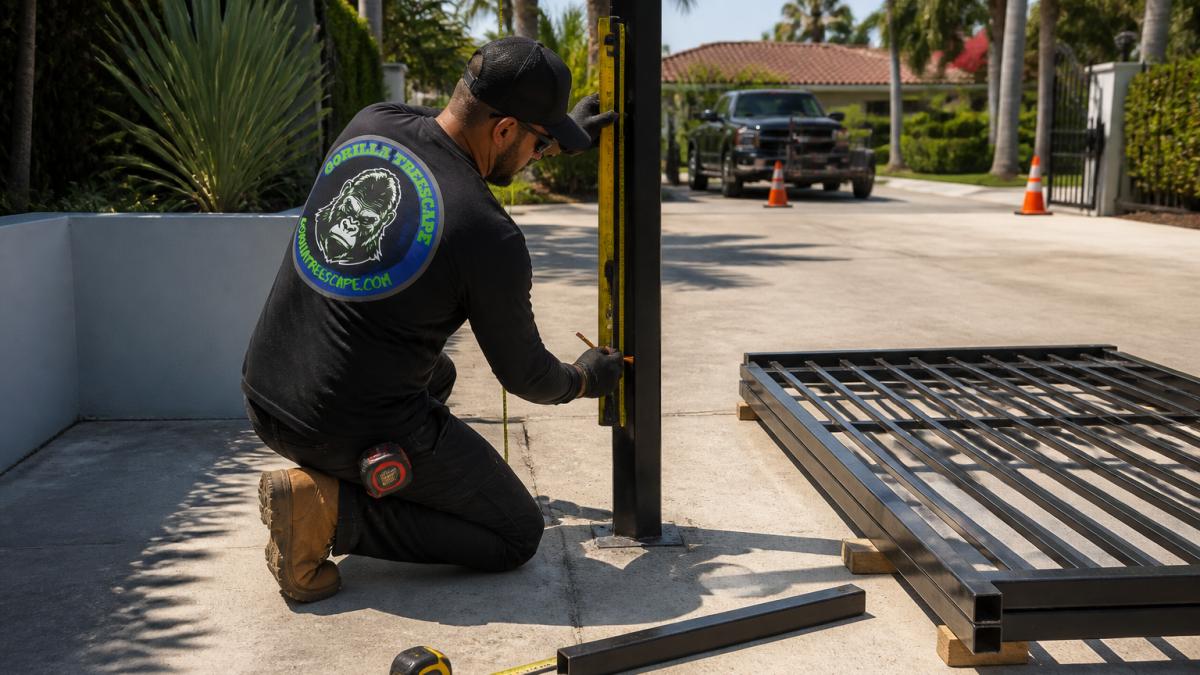
Step 3: Post Setting and Footings
This is the step that decides the gate's lifespan. Posts are set in concrete footings sized to the gate's weight and the local wind load, and the footing depth matters more than the diameter. A common failure pattern is a shallow footing that lets the post lean after the first wet season.
Key mechanics:
- Footing depth. Deeper than the frost line is not the concern here; resistance to soil movement and wind uplift is. Footings are typically set well below the surface and bell out at the base for uplift resistance.
- Concrete cure. Posts should not be loaded until the concrete reaches adequate strength. Rushing this step is how gates end up out of plumb.
- Hardware placement. Hinge plates, track brackets, and operator mounts are set while the posts are still adjustable, not after the concrete sets.
Step 4: Gate Mounting, Frame, and Operator Wiring
With posts cured, the gate is hung or the track is mounted, then squared and shimmed so it cycles without binding.
- Swing gates: hinges are welded or bolted to the frame, and the gate is checked for plumb and swing clearance through its full arc.
- Sliding gates: the track or cantilever carriage is leveled, and the gate is aligned so it rolls without dragging.
- Operator wiring: low-voltage control wiring runs to the keypad, sensors, and any safety edges, while line voltage feeds the operator. Photoelectric sensors are mounted at the gate line and aligned so the beam is not broken by the gate itself.
Step 5: Testing, Safety Check, and Final Inspection
Before the gate goes into service, it is cycled repeatedly and every safety device is tested:
- Photoelectric sensors are interrupted mid-travel to confirm the gate stops and reverses.
- The manual release is exercised so the gate can be opened by hand during a power outage.
- The keypad and remotes are programmed and range-tested.
Then the final inspection is scheduled. The inspector verifies the permit scope, the electrical work, and the entrapment protection. Keep the approved permit and inspection record; a future buyer's inspector will ask for them.
Driveway Gate Installation: Materials, Design, and Cost Factors
Driveway gate installation is where material choice, opening width, automation, and site conditions collide. Here is how each one moves the project.
Material Comparison
| Material | Corrosion Resistance | Maintenance Level | Relative Cost | Best For |
|---|---|---|---|---|
| Aluminum | High | Low | Moderate | Coastal properties, humid air, powder-coated finishes |
| Wrought iron | Moderate | Medium | High | Decorative entrances, custom designs |
| Steel (galvanized) | Moderate | Medium | Moderate | High-security openings, commercial use |
| Wood | Low | High | Varies | Shaded, inland yards, privacy styles |
| Chain link | High | Low | Low | Utility and pet containment |
A few trade-offs worth knowing:
- Aluminum is the default near the coast because it does not rust the way ferrous metals do, and a powder-coated finish adds another layer of protection. It is lighter, which means the operator and hinges work less hard.
- Wrought iron looks the part but needs periodic repainting, and any chip in the finish becomes a rust point in salt air.
- Galvanized steel balances strength and cost, but the zinc coating wears at cut edges and welds, so those spots need touch-up.
What Drives the Cost
Pricing depends on gate size, material, automation, and site conditions, so we quote each project individually. The variables that move an estimate the most:
- Opening width and gate weight. Wider, heavier gates need stronger frames, heavier hinges or track, and a larger operator.
- Material. Wrought iron and custom designs sit at the top; aluminum and chain link sit lower.
- Automation. Adding an operator brings the motor, control board, safety sensors, keypad, remotes, and wiring.
Request a quote from Gorilla Treescape LLC for your specific driveway and we will break down labor, materials, and permit handling.
Sliding Driveway Gate vs. Swing Gate: Which Fits Your Property?
A sliding driveway gate moves horizontally along a track or cantilever system, while a swing gate pivots on hinges to open inward or outward.
Sliding gates suit sloped driveways and tight aprons where a swing arc would hit a parked car.
A common mistake is choosing the gate style before measuring the swing clearance. In practice, the driveway decides for you.
Automatic Gate Safety Features You Should Not Skip
Automatic gate safety features are the difference between a convenient entrance and a liability. Every automatic gate should include photoelectric sensors that stop or reverse the gate when something crosses the beam, plus an inherent reversing system built into the operator.
- Photoelectric sensors mounted at the gate line
- Reversing edge or inherent entrapment protection
- Warning signs posted on both sides of the gate
The UL 325 standard for gate operators sets the entrapment protection requirements that automatic gate operators must meet. Ask any installer to confirm their operator and sensors comply before the gate goes live.
Miami Climate and Corrosion Protection for Gates
Salt air, humidity, and heavy rain shorten the life of any gate that is not protected. Aluminum with a powder-coated finish holds up best near the coast.
Corrosion protection comes down to three habits: rinse the gate and hardware monthly during hurricane season, touch up chips immediately, and keep hinges, tracks, and the operator lubricated. Stainless steel hardware costs more upfront and lasts far longer in coastal air.
DIY vs. Professional Gate Installation
DIY gate installation only makes sense for small, manual gates on flat ground with no electrical work. Anything automatic, anything over a standard single-car width, and anything requiring a permit belongs with a licensed installer.
Here is the honest trade-off. A DIY swing gate can save on labor, but a mis-set post means the gate sags within a season.
- DIY is realistic for: light manual gates, garden gates, flat ground, no permit required
- Professional installation is required for: automatic operators, driveway-width gates, sloped ground, HOA or permit projects
- The hidden DIY cost: redoing post footings and re-hanging a gate that never seated correctly
For most Miami-Dade and Broward properties, professional installation pays for itself in one avoided redo.
Conclusion: Planning Your Gate Installation in Miami
The homeowners who end up happy with their fence are the ones who planned the whole entrance, not just the fence itself. A fence that matches your fence line, your driveway, and your landscaping looks intentional.
Gorilla Treescape LLC handles fence work as part of full outdoor projects, from landscaping and outdoor living design to driveways and decks. We manage permits, coordinate the trades, and keep you updated from concept to completion.
Frequently Asked Questions
How do I choose the right gate for my driveway?
Start with your available space and how you use the driveway. Swing gates need a clear arc to open and close, so they suit wider lots. Sliding gates move along a track or cantilever and work well where the driveway is long but the side yard is narrow. Material matters too: aluminum resists rust in humid conditions, while steel offers strength but needs more frequent painting. Also factor in whether you want manual or automatic operation, and check any HOA or local code limits on height and style before ordering.
What should I check before installing a driveway gate?
Before you dig, confirm property lines, utility locations, and any easements that cross the gate area. Check with Miami-Dade or Broward County for permit requirements, and get HOA approval in writing if your community has architectural rules. Measure the opening at its narrowest point and note the ground slope, since a sloped driveway changes how a swing or sliding gate must be hung. Finally, decide where power will come from if you plan an automatic gate, because running conduit is far easier before the concrete is poured.
What is the difference between a sliding gate and a swing gate?
A swing gate pivots on hinges at one side and needs clear space to swing open, usually inward or outward. A sliding gate moves horizontally along a track or cantilever system and needs clear space along a fence line instead. Sliding gates suit narrow or sloped driveways where a swing arc would hit a wall or parked car. Swing gates often cost less to install and are simpler to automate, but they require more clearance. Both can be manual or automatic, and both need sturdy posts set in concrete for stability.
What safety features should an automatic gate have?
Every automatic gate should have at least two independent safety devices. Photoelectric sensors, also called photo eyes, stop or reverse the gate when something breaks the beam. A sensing edge on the gate leaf detects contact and reverses motion. For extra protection, add a loop detector buried in the driveway to sense vehicles, and a manual release so the gate can be opened during a power outage. Warning signs and blinking lights are also required in many installations. Test all safety devices monthly and after any storm.
A gate is only as good as the ground and the paperwork beneath it. If you want the entrance, the driveway, and the landscaping handled as one project, Gorilla Treescape LLC brings permit handling, design, and construction under one team. We handle permits for projects in under two months and manage everything from concept to completion. Get started with Gorilla Treescape LLC and get a gate that still lines up straight after storm season.