 how-to
Back Yard Deck Installation in Miami: A How-To Guide
Table of Contents
- Back Yard Deck Installation in Miami: What to Know First
- Best Decking Materials for Humidity
- Deck Permit Requirements in Miami-Dade
- Average Deck Installation Timeline
- Step-by-Step Deck Installation Process
- Common Mistakes to Avoid
- Caring for Your New Deck in Miami's Climate
- Frequently Asked Questions
Last Updated: October 2, 2026
Back Yard Deck Installation in Miami: What to Know First
Back yard deck installation in Miami is a permitting-and-materials problem before it is a carpentry problem.
Here's what actually matters.
Miami-Dade enforces one of the strictest building codes in the country, largely because of wind.
The good news: a properly permitted, properly framed deck is one of the highest-return exterior projects you can do.
This guide walks through materials, permits, timelines, and the installation steps in order.
Best Decking Materials for Humidity
The best decking materials for humidity are dense tropical hardwoods and capped composite boards, because both resist moisture absorption, warping, and rot far better than standard pressure-treated pine. But in South Florida, humidity is only half the story. Salt air and year-round sun change how each material ages, and the gap between a board that lasts 10 years and one that lasts 30 comes down to how it handles both.
Here's how the three main options actually behave in this climate:
- Ipe wood - A Brazilian hardwood so dense it's often compared to concrete for durability. It handles humidity, resists insects, and lasts decades with minimal fuss. The trade-off is cost and installation difficulty; it requires pre-drilling and sharp blades. In salt air, ipe's natural density slows moisture uptake, but the surface will still gray over time unless it's oiled. Most practitioners find that ipe needs re-oiling every one to two years to hold its color, and the fasteners matter more than the boards: stainless steel is the only hardware that won't bleed rust stains into the wood.
- Capped composite decking - A wood-plastic core wrapped in a protective polymer shell. It won't splinter, doesn't need staining, and holds color well under harsh sun. The cap is what makes it work in this climate: it blocks moisture from reaching the wood-plastic core, which is the part that would otherwise swell and rot. Best for homeowners who want low maintenance. The trade-off is heat retention. Composite surfaces run hotter under direct sun than wood, which matters if you plan to walk on it barefoot in July.
- Pressure-treated pine - The budget option. It works, but in Miami's humidity it needs regular sealing and will likely need replacement sooner than the alternatives. Salt air accelerates corrosion on the fasteners and the wood itself moves more with seasonal moisture swings. A pressure-treated deck can perform well if it's sealed on schedule and built with hot-dipped galvanized or stainless hardware, but it is the shortest-lived of the three in this environment.
A practical way to decide: if you want the longest service life and don't mind annual oiling, ipe is the benchmark. If you want to skip the maintenance routine entirely, capped composite is the better fit. If budget drives the decision, pressure-treated pine can work, but plan on sealing it every year and inspecting fasteners each spring.
Deck Permit Requirements in Miami-Dade
Deck permit requirements in Miami-Dade depend on height, size, and whether the deck attaches to your home, but most residential decks need a building permit and at least one inspection.
Here's the general picture:
- Decks under 30 inches above grade often qualify for simplified review, but you still need to confirm with your local building department.
- Decks attached to a house almost always require a permit, because they affect the structure.
- Decks over a certain height need engineered drawings showing wind-load compliance.
- HOA communities add a second layer of approval, usually on materials and color.
The exact thresholds and fees change, so check your municipality's building department directly for current requirements. Miami-Dade County's building code resources list the submission steps.
This is where most projects stall. A homeowner builds first and asks later, then has to tear it out.
Average Deck Installation Timeline
The average deck installation timeline runs two to four weeks from permit approval to final inspection, though the permit itself can take longer than the build.
Here's how it typically breaks down:
| Phase | Typical Duration | What Happens |
|---|---|---|
| Design and permit submission | 1-3 weeks | Drawings, HOA approval, filing |
| Permit review and approval | 2-6 weeks | Municipal review, revisions |
| Site prep and foundation | 2-4 days | Clearing, grading, footings |
| Framing | 3-5 days | Joists, beams, structural work |
| Decking and railings | 4-7 days | Board installation, railing systems |
| Inspection and punch list | 1-2 weeks | Final inspection, fixes |
Weather adds time. Afternoon storms are a given in summer, and rain delays footing pours and finish work.
The single biggest schedule killer is the permit. Homeowners who file before ordering materials save weeks.
Step-by-Step Deck Installation Process
The installation process moves through three phases: site preparation, framing, and finishing. Each one has to be right before the next begins.
Site Preparation and Foundation
Site prep starts with grading and drainage, because a deck built over poor drainage will rot from the bottom up. Crews clear the footprint, level the ground, and confirm water flows away from the house.
Footings come next. These are concrete piers poured below the frost line (not a factor here) and below grade to a depth that satisfies local code.
Framing and Structural Integrity
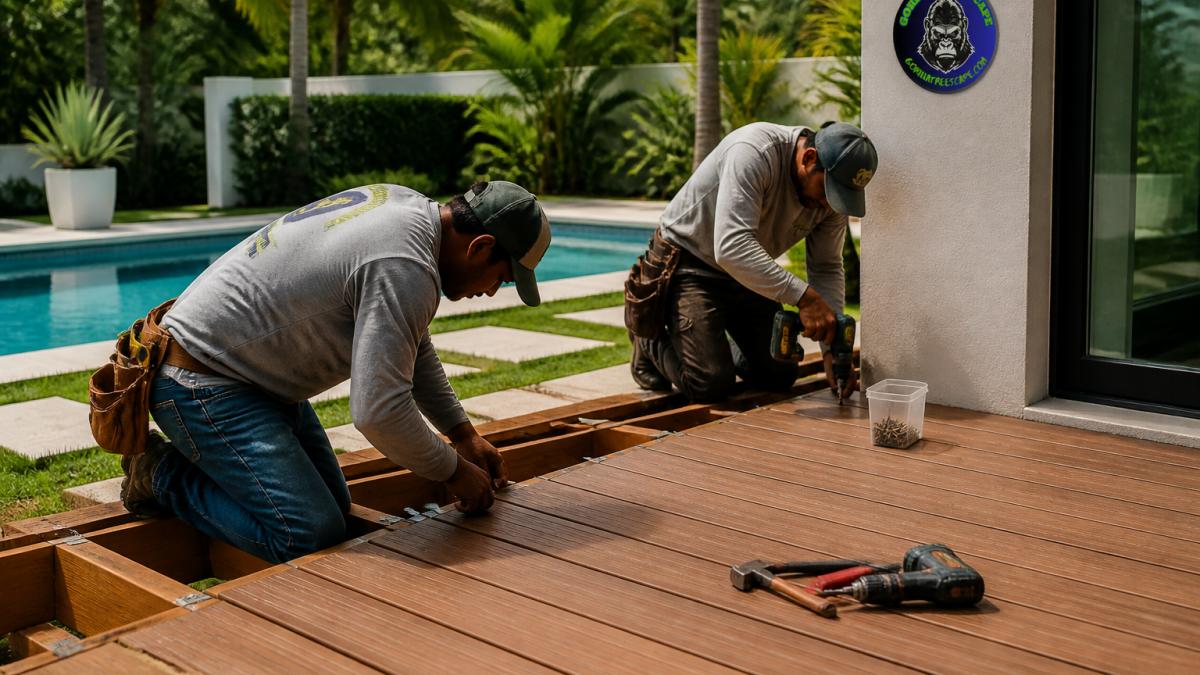
Framing carries the load, so it's where structural integrity is won or lost. Joists, beams, and ledger boards are sized to the span and the wind-load requirements in the Florida Building Code.
Key framing points:
- Ledger attachment - The board connecting the deck to your house must be properly flashed and bolted, or water gets behind your siding.
- Joist spacing - Tighter spacing means a stiffer deck and less board flex.
- Hurricane hardware - Connectors rated for high wind hold the frame together under uplift.
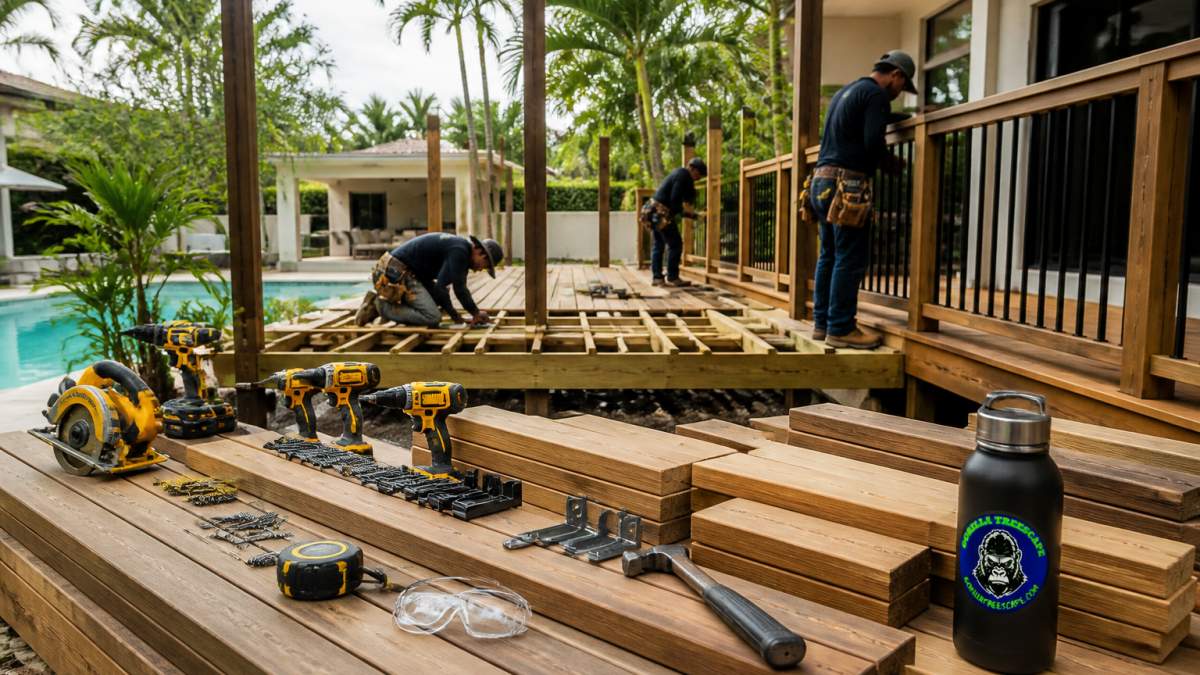
Decking, Railings, and Finishing Touches
Decking installation is the visible payoff. Boards go down with consistent gaps for drainage and airflow, fastened with corrosion-resistant screws.
Railing systems follow local code for height and baluster spacing. Then come the finishing touches: stairs, lighting, and any built-in seating.
This is also where a deck becomes an outdoor living space. Adding a pergola or shade structure overhead turns a flat platform into a room. If you want the full picture of what's possible, our landscaping and outdoor living design service covers decks, patios, and shade in one plan.
Common Mistakes to Avoid
The most common deck installation mistakes are poor drainage planning, undersized framing, and skipping the permit. Each one is expensive to fix later.
- Ignoring drainage. Water pooling under the deck rots framing and attracts pests.
- Using the wrong fasteners. Standard hardware corrodes in salt air within a few seasons.
- Undersizing the frame. A frame built for looks rather than load will sag and flex.
- Forgetting the HOA. Material and color approvals can take weeks; get them early.
- Skipping the inspection. Unpermitted decks create legal and resale problems.
Caring for Your New Deck in Miami's Climate
Deck maintenance in Miami means annual cleaning, periodic sealing for wood decks, and a fastener check before hurricane season. Composite boards need less work but still need cleaning.
A simple routine:
- Rinse monthly to remove salt and pollen buildup. Salt residue pulls moisture into wood and accelerates corrosion on metal hardware, so a quick rinse does more than keep the surface clean.
- Deep clean twice a year with a deck-safe cleaner. Avoid chlorine bleach on wood, which can break down the fibers; oxygenated cleaners are gentler and still lift mildew.
- Seal wood decks as recommended by the manufacturer, usually every one to two years. In this climate, the sun and humidity work together to break down sealant faster than in drier regions, so don't stretch the interval.
- Check fasteners and railings each spring, before storm season. Look for rust streaks, loose screws, and any railing that moves when you push on it. A deck that passes a spring inspection is far less likely to lose boards in a wind event.
- Clear debris from between boards so water drains freely. Leaf litter and pollen combine into a mat that holds moisture against the boards and framing.
Wood versus composite changes the schedule.
Hurricane season adds one more task.
Curb appeal and structural integrity both depend on this routine. A well-maintained deck lasts far longer than one left to the weather.
If you'd rather hand the whole thing off, our team handles maintenance alongside pool and patio care, so your outdoor space stays in shape year-round.
Frequently Asked Questions
What permits are required for deck installation?
In Miami-Dade County, most decks require a building permit, especially if they are attached to your home, raised more than 30 inches, or exceed 200 square feet. You will need to submit construction drawings showing the foundation, framing, and railing details. The permit process also includes inspections at key stages. Working with a contractor experienced in local deck permit requirements can help you avoid delays and ensure your deck meets safety codes.
Which materials are best for decks in humid climates?
For Miami's humidity, composite decking and hardwood decking like Ipe are top choices. Composite resists moisture, rot, and insects, and never needs staining. Ipe is naturally dense and weather-resistant, though it requires occasional oiling. Pressure-treated pine is a budget option but needs regular sealing to prevent warping and mold. Avoid untreated softwoods, which deteriorate quickly in humid conditions.
How long does a typical deck installation take?
The average deck installation timeline is 2 to 4 weeks for a standard 300-square-foot deck, including permitting and inspections. Custom designs with multi-level features or pergolas may take 6 to 8 weeks. Weather delays and material lead times can extend the schedule. A professional contractor will provide a detailed timeline during the planning phase so you know what to expect.
Do I need a professional contractor for my deck project?
While some homeowners tackle small ground-level decks as DIY projects, hiring a professional is recommended for raised or multi-level decks, especially in Miami-Dade where building codes are strict. A licensed contractor handles deck permit requirements, ensures structural integrity, and manages inspections. They also carry insurance, protecting you from liability. For a safe, long-lasting deck, professional installation is a wise investment.