 how-to
How to Maintain Commercial Irrigation Systems
Table of Contents
- Conduct Routine Visual Inspections of Your Irrigation System
- Inspect Sprinkler Heads and Nozzles for Damage and Blockage
- Create a Commercial Irrigation Maintenance Checklist
- Establish an Irrigation Maintenance Schedule
- Find and Repair Leaks and Pipe Damage
- Troubleshoot Common Commercial Irrigation Problems
- Program and Adjust Irrigation Controllers
- Test System Performance and Water Use
- Frequently Asked Questions
Last Updated: October 17, 2026
Conduct Routine Visual Inspections of Your Irrigation System
To maintain commercial irrigation systems effectively, start with regular visual inspections. Walk your property systematically to catch problems before they become expensive repairs.
Check for visible damage and water pooling
Look for wet spots, soggy areas, or standing water where the ground should be dry, these indicate leaks underground or at connection points.
Check visible pipes, connections, and above-ground components for cracks, splits, or corrosion, especially at joints and fittings.
Document what you find with photos to track which issues are getting worse.
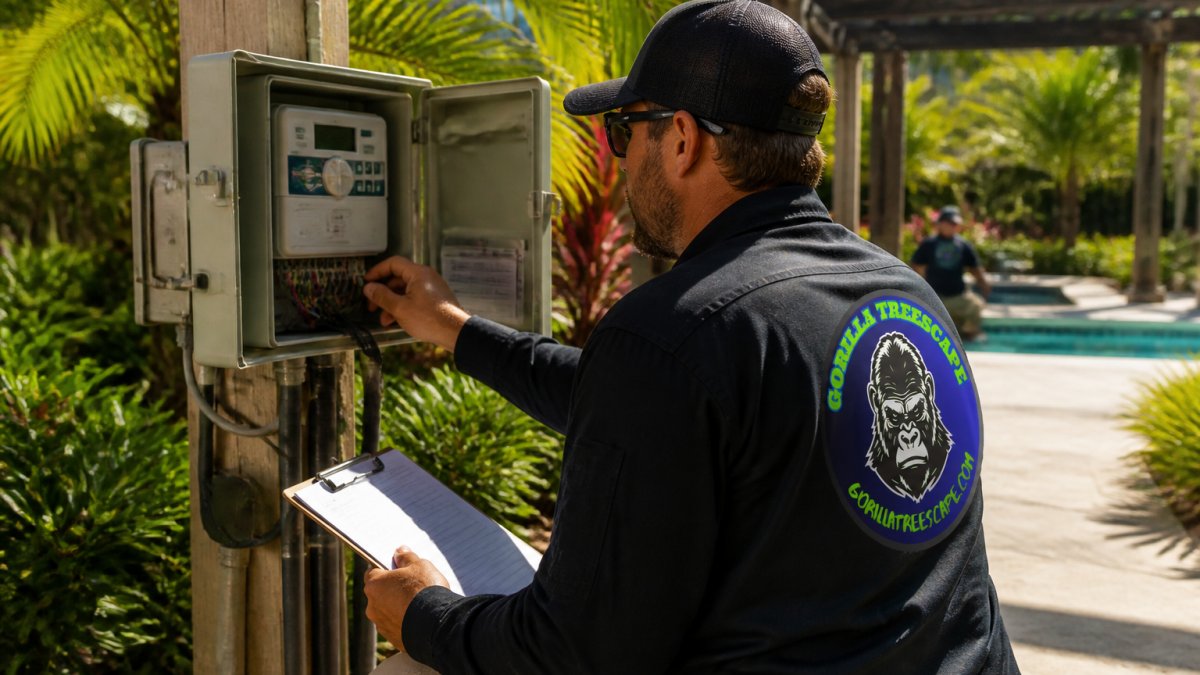
Verify controller and timer operation
Check that the controller shows the correct time and date and that the display is readable and undamaged.
Advance the controller manually through a cycle, watching zones activate in sequence and listening for solenoid valves to click open.
Confirm the controller is protected from sun, rain, and temperature extremes; if not, add a weatherproof enclosure.
Inspect Sprinkler Heads and Nozzles for Damage and Blockage
Sprinkler heads take the most abuse, mowers hit them, foot traffic crushes them, and debris clogs them.
Test spray patterns and coverage uniformity
Run each zone individually and observe the spray pattern.
Walk the spray zone and feel for consistent moisture; dry spots mean poor coverage, weak spray means pressure loss or blockage.
Misting or fog instead of a solid stream indicates a partially clogged nozzle, clean or replace it.
Identify misaligned or sunken heads
Sunken heads spray into the ground; misaligned heads spray onto pavement, buildings, or the wrong zone.
If a head sits below grade, soil has settled or the head has sunk, mark it for adjustment or replacement.
Rotate the head manually through its full range; if it sticks, corrosion or debris is inside, clean or replace it.
Create a Commercial Irrigation Maintenance Checklist
A written checklist ensures nothing gets missed and creates accountability when tasks are assigned.
Monthly and quarterly inspection tasks
Monthly tasks:
- Walk all zones and look for visible damage
- Check controller display and verify time/date
- Test one zone manually to confirm valve operation
- Look for wet spots or standing water
Quarterly tasks:
- Clean or replace all nozzles
- Inspect all visible pipes and connections
- Check sprinkler head alignment and height
- Verify water pressure at each zone
- Review coverage uniformity across zones
Seasonal tasks (spring and fall):
- Flush all lines to remove sediment
- Check backflow prevention device operation
- Inspect underground sections for leaks
- Test all solenoid valves
- Verify timer settings for season
Documentation and record-keeping
Keep records of every inspection and repair, date, findings, and fixes. This history reveals patterns; a zone that keeps failing points to a systemic problem.
Use a simple spreadsheet or maintenance log with columns for date, zone, issue, action taken, and technician, plus attached photos.
Establish an Irrigation Maintenance Schedule
To maintain commercial irrigation on a commercial property, use a maintenance schedule as a management tool: a site-specific cadence tied to your zones, water source, climate, and compliance obligations, plus a way to prioritize work when the list is longer than the crew.
Build a site-specific schedule by zone and season
Start with an asset inventory, every controller, zone, valve, backflow device, flow meter, and sensor, with location and design flow, then assign each zone a maintenance tier. High-visibility zones (entrances, client-facing beds, athletic fields) get the shortest interval; low-traffic perimeter zones can go longer. A workable cadence:
- Weekly during peak season: visual walk of high-visibility zones, controller status check, meter reading, and a quick flow-versus-design comparison.
- Monthly: full walk of all zones, catch-can spot checks on rotating zones, sensor and communication verification, and log update.
- Quarterly: nozzle and filter cleaning, pressure and DU testing, valve and solenoid exercise, and a review of the performance log for degrading zones.
- Seasonal: spring commissioning and fall shutdown, with backflow testing scheduled around your water utility's requirements.
Adjust intervals for climate and water restrictions: shorten the cycle in hot, dry periods, lengthen it in cool, wet ones, but keep meter and leak checks on schedule.
Prioritize repairs with a risk-based work order
Rank issues by consequence: a mainline leak or failed backflow device outranks a single misaligned head. A simple priority scheme:
- Priority 1 (same day): mainline breaks, backflow failures, stuck valves, and anything causing property damage or a compliance risk.
- Priority 2 (this week): zone-level leaks, failed heads, pressure problems affecting coverage.
- Priority 3 (next scheduled cycle): misalignment, nozzle wear, minor coverage gaps, cosmetic issues.
Put each finding on a work order with zone, location, priority, technician, and date, then record the repair and re-test the zone.
Document compliance and backflow testing
Commercial systems connected to a public water supply typically require a backflow prevention device, and many utilities require annual testing by a certified tester with results filed with the utility. Confirm the requirement with your provider, keep the test report on file, and schedule testing before the deadline, a failed or overdue test can trigger a service interruption.
Winterize and commission large systems deliberately
In freezing climates, winterization is a scheduled procedure: shut off the main, drain mainlines and zone lines, blow out with compressed air at a pressure that won't damage components (follow manufacturer guidance for your pipe and valve ratings), and protect the backflow device and controller.
Find and Repair Leaks and Pipe Damage
Leaks waste water and money and create soggy areas where roots rot and weeds thrive. Finding them quickly minimizes damage.
Detect underground leaks and wet spots
Walk your property after the system runs. Wet spots that don't match the spray pattern indicate underground leaks.
Listen for hissing sounds during operation, running water under pressure makes noise when it escapes.
Check your water meter before and after a watering cycle.
Assess connections and fittings for wear
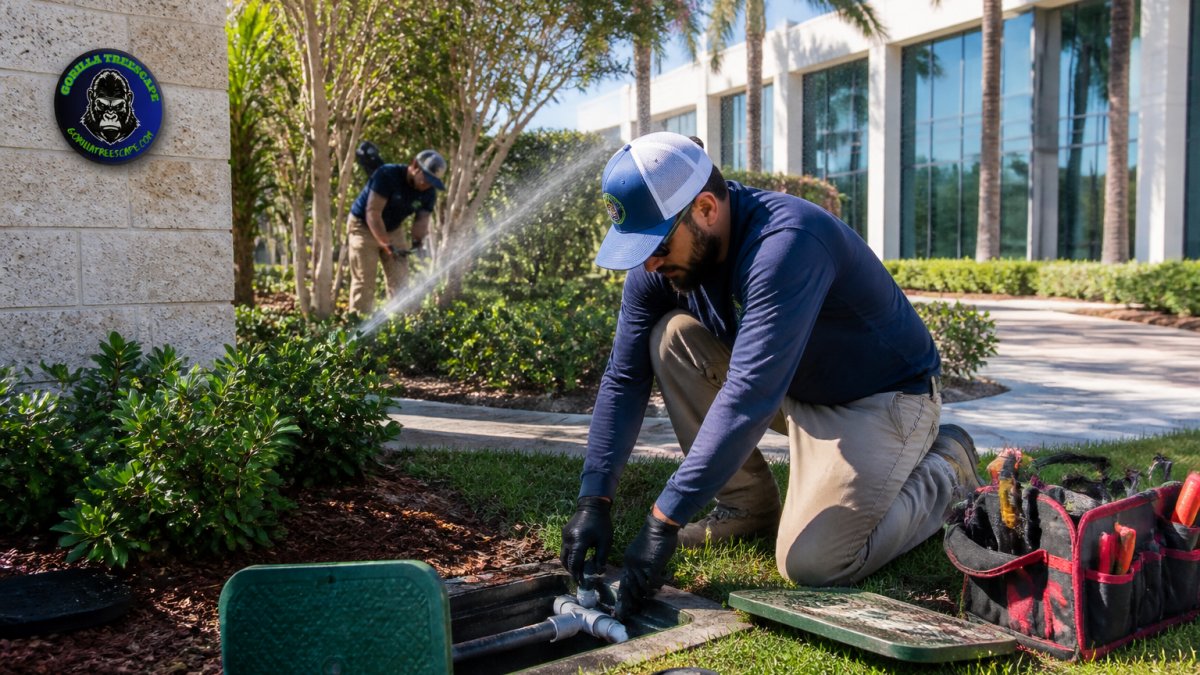
Leaks most commonly occur at connections. Inspect every joint for drips or seeping. Tighten fittings by hand first. Many small leaks stop with a quarter-turn tightening.
If tightening doesn't stop the leak, the fitting needs replacement. Turn off the zone, unscrew the leaking connection, and install a new fitting.
Check underground sections by digging carefully at suspected leak locations. For properties where irrigation runs through landscaped areas, coordinating repairs with Landscaping & Pool Maintenance can help ensure that any excavation or ground disturbance is managed alongside your broader landscape care.
Troubleshoot Common Commercial Irrigation Problems
Most problems fall into a few categories. Knowing the symptoms helps you diagnose and fix them quickly.
Low water pressure and uneven coverage
Low pressure causes weak spray patterns and incomplete coverage. Check the water source first.
Clogged filters reduce pressure. Dirty filters block water flow. Clean or replace filters if pressure is low.
Leaks also reduce pressure. A leak upstream of the zone reduces pressure to all downstream heads.
Overwatering, underwatering, and schedule conflicts
Overwatering wastes water and promotes disease. Underwatering stresses plants and kills grass.
If some zones run too long and others too short, verify the timer is programmed correctly.
Weather changes the watering need. In rainy periods, reduce watering. In dry periods, increase it.
Program and Adjust Irrigation Controllers
Modern controllers let you set precise run times for each zone. Understanding how to program them gives you control over water use and coverage.
Set zone run times and water distribution
Access your controller's programming menu. Most controllers have buttons or a touchscreen interface.
Set the start time for when you want watering to begin.
Program multiple start times if you want zones to run at different times.
Test each zone after programming to verify it runs correctly and for the right duration.
Integrate smart sensors and weather data
Smart controllers can connect to weather stations and soil moisture sensors. These devices adjust watering automatically based on real conditions.
A rain sensor shuts off watering when it rains. Soil moisture sensors measure water in the root zone and only water when needed.
If your controller supports weather data integration, enable it.
Test System Performance and Water Use
Testing is what turns maintenance from guesswork into a managed program. On a commercial property with dozens of zones, you need numbers you can compare month over month, not just a visual sense that the system "looks fine." Build a small performance record for every zone and update it on each inspection cycle.
Measure pressure, flow, and distribution uniformity
Start with static and dynamic pressure.
Measure flow with a calibrated bucket or, better, a dedicated flow meter on the mainline. Time how long it takes to fill a container of known volume and convert to gallons per minute (GPM).
Distribution uniformity (DU) is the metric most commercial operators skip and most need.
Track water consumption and leak-related use
Read the main water meter at the same time each week and record the reading alongside irrigation run hours.
Run a simple leak audit: with all irrigation off and no other water use on the property, watch the meter for 15 to 30 minutes.
Audit central controllers and sensor inputs
On a central or smart controller, performance testing also means verifying the control layer.
Check communication between the central controller and field satellites or decoders. Look for zones that report "on" but show no flow, or flow with no command.
Frequently Asked Questions
How often should a commercial irrigation system be inspected?
Commercial irrigation systems should be inspected at least monthly during the growing season and before seasonal transitions. Weekly checks during peak summer use help catch pressure drops, leaks, or controller failures early. Before winterization and again in spring, conduct a full system assessment including all connections, valves, and spray patterns. Frequent inspections reduce water waste and prevent expensive repairs from undetected damage.
What should be included in a commercial irrigation maintenance checklist?
A comprehensive commercial irrigation maintenance checklist should cover visual inspection of pipes and fittings for leaks, sprinkler head alignment and blockage, nozzle cleanliness, water pressure readings, controller programming accuracy, and zone coverage uniformity. Include checks for mower damage, foot traffic damage, and sediment buildup in filters. Document all findings, repairs, and water use metrics. Schedule seasonal tasks like winterization, backflow prevention testing, and system flushing to stay compliant and maintain efficiency.
How do you find leaks in a commercial irrigation system?
Start by observing the landscape for wet spots, unusually green patches, or sunken areas that indicate underground leaks. Check water meter readings before and after system shutdown to detect hidden flow loss. Inspect all visible pipes, connections, and fittings for dripping or moisture. Listen for hissing sounds near suspected leak zones. For difficult-to-locate leaks, use a pressure gauge to monitor drop-offs in specific zones, or hire a professional with leak detection equipment to pinpoint underground damage before it causes major water loss or property damage.
When should irrigation sprinkler heads be cleaned or replaced?
Clean sprinkler heads and nozzles quarterly or whenever you notice reduced water flow, clogged spray patterns, or debris buildup. Debris, mineral deposits, and sediment commonly block nozzles in areas with hard water. Replace heads that are cracked, misaligned, or no longer adjust properly. Sunken heads that sit below turf level should be raised to restore proper spray coverage. During seasonal inspections, replace any heads showing wear or damage to prevent uneven water distribution and maintain system performance across all zones.
Maintaining your commercial irrigation system doesn't have to be complicated, but it does require commitment. The cost of preventive maintenance is far less than emergency repairs or water waste. Our team at Gorilla Treescape LLC can help you establish a maintenance program tailored to your property's specific needs. Get a quote today and discover how professional maintenance can extend your system's life and improve your landscape's health.