 ultimate-guide
Commercial Property Exterior Maintenance Schedule
Table of Contents
- Why a Commercial Property Exterior Maintenance Schedule Protects Your Investment
- Core Components of a Commercial Landscaping Maintenance Checklist
- How to Build a Seasonal Property Maintenance Plan
- When to Schedule Commercial Exterior Building Cleaning Services
- Daily, Weekly, and Monthly Tasks for Your Exterior Maintenance Schedule
- Digital Maintenance Tracking Tools and Documentation
- Budgeting and Vendor Procurement for Exterior Maintenance
- Frequently Asked Questions
Last Updated: September 17, 2026
Why a Commercial Property Exterior Maintenance Schedule Protects Your Investment
A commercial property exterior maintenance schedule is a documented calendar of recurring inspections, cleaning, landscaping, and repair tasks that protects a building's structural integrity and property valuation. At Gorilla Treescape LLC, we build these schedules for property managers who need predictable results rather than reactive firefighting.
Deferred maintenance is the silent killer of commercial real estate value. A clogged drainage system in October becomes a flooded walkway in June. A hairline crack in the building envelope becomes a roof membrane replacement. The Whole Building Design Guide maintenance guidance makes the case plainly: planned upkeep costs a fraction of corrective repairs.
Below, we'll show you exactly how to structure a schedule that holds up across all four seasons, plus the documentation habits that keep liability exposure low.
Core Components of a Commercial Landscaping Maintenance Checklist
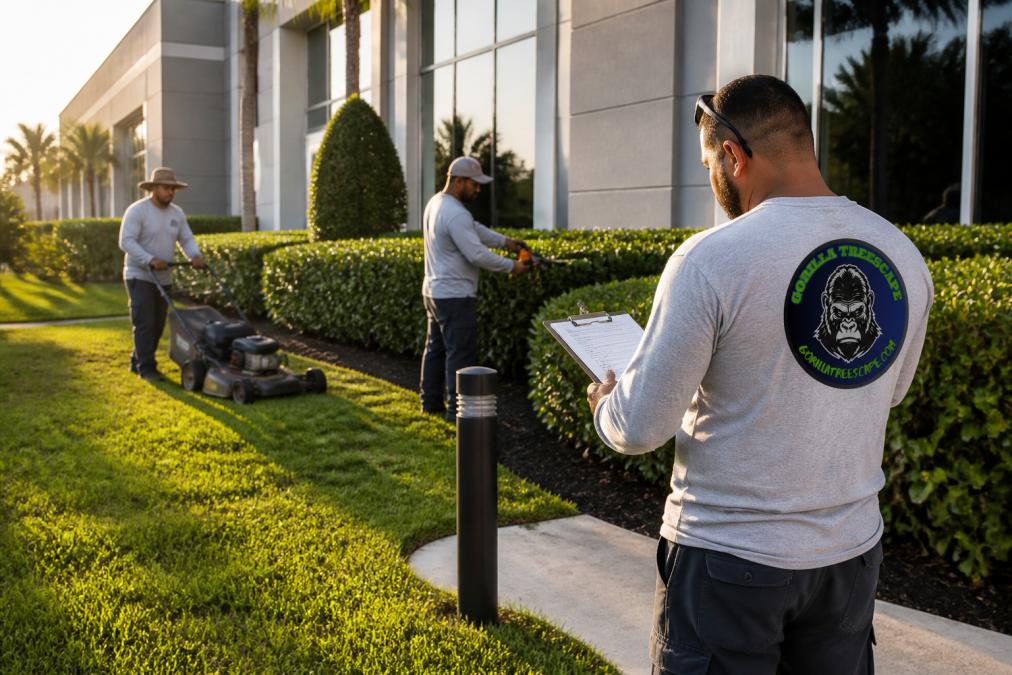
A commercial landscaping maintenance checklist covers categories such as grounds and turf, irrigation, and hardscape. Skipping any one of them creates a weak point that shows up later as a repair bill.
Grounds, Irrigation, and Hardscape Checks
Turf health, debris removal, and landscaping irrigation audits belong on a monthly rotation. Walk the property after every storm to catch standing water before it becomes a mosquito problem or a cracked asphalt issue.
Hardscape gets neglected most often. Parking lot striping fades, asphalt repair needs grow, and walkway safety degrades quietly. Inspect these quarterly at minimum.
Building Envelope and Roof Membrane Inspections
Check caulking, seals, and exterior lighting mounts twice a year.
How to Build a Seasonal Property Maintenance Plan
A seasonal property maintenance plan divides the year into four work cycles, but the calendar alone is a weak organizing principle. Two properties in the same month can face completely different exterior risks depending on their climate zone. The stronger approach is to build a climate-zone matrix first, then layer the calendar on top of it.
Build a Climate-Zone Matrix Before the Calendar
Start by mapping your property to one of four broad exterior-stress profiles. Each profile shifts which tasks are urgent, which can wait, and which need a second pass.
| Climate Profile | Dominant Exterior Stress | Schedule Shift |
|---|---|---|
| Freeze-thaw | Ice damming, salt damage, hardscape heaving | Inspect hardscape and drainage after every freeze-thaw cycle, not just quarterly |
| Hot-humid | Organic growth, moisture intrusion, storm loading | Move drainage checks earlier; add a post-storm walk |
| Arid-high UV | Sealant degradation, fading, dust intrusion | Shorten sealant and coating inspection intervals; prioritize shade and irrigation audits |
| Temperate-wet | Moss, leaf load, standing water | Front-load drainage clearing before leaf drop; inspect walkways monthly |
Spring and Summer Priorities
Spring is inspection season. Clear winter debris, test irrigation zones, and refresh mulch beds. Summer shifts to upkeep: mowing frequency increases, exterior lighting gets checked for outages, and drainage is re-cleared after heavy rain.
Fall and Winter Preparation
Fall is prep season. Clear drainage systems before leaf drop overwhelms them, schedule debris removal, and document any damage for spring budgeting. Winter focuses on stormwater management, hazard mitigation, and protecting exterior utility units from ice and debris.
Tie Each Season to a Documentation Output
A seasonal plan only protects you if each cycle produces a record. At minimum, each season should generate an inspection log, a photo set of any changed conditions, and a work order history for completed tasks. That record is what demonstrates due diligence when an insurance claim or compliance review lands, and it is the mechanism most generic seasonal guides skip entirely.
When to Schedule Commercial Exterior Building Cleaning Services
Commercial exterior building cleaning services should run twice yearly for most properties, with additional pressure washing after storm season or pollen-heavy months. Frequency depends on your façade material, tree canopy, and local pollution levels.
Daily, Weekly, and Monthly Tasks for Your Exterior Maintenance Schedule
Daily tasks are quick visual sweeps. Weekly tasks are functional checks. Monthly tasks are documentation and deeper inspection cycles. The cadence matters less than the record it produces, a task that is done but not logged does not protect you.
| Frequency | Task | Owner | Documentation Output |
|---|---|---|---|
| Daily | Litter and debris sweep, walkway safety check | Grounds staff | Signed daily sweep log |
| Weekly | Irrigation zone test, exterior lighting check | Maintenance tech | Work order with pass/fail notes |
| Monthly | Inspection log update, drainage review | Facility manager | Dated inspection report with photos |
| Quarterly | Asphalt repair assessment, striping review | Vendor | Vendor inspection report |
| Annually | Full compliance audit, capital planning | Property manager | Audit summary and capital reserve update |
Why the Documentation Is the Real Deliverable
Most guides treat the log as an afterthought. In practice, the log is the asset. When a slip-and-fall claim or a compliance audit arrives, the first thing a reviewer asks for is the maintenance history. A consistent daily sweep log and a dated inspection report are what demonstrate that the property was actively managed rather than neglected.
Assign an Owner to Every Line
A cadence table without named owners is a wish list. Every row should have a single accountable role, not a department. When the daily sweep has no named owner, it is the first task dropped during staffing shortages, and it is also the task most likely to appear in a liability claim.
Review the Cadence Quarterly
Cadence is not static. After each quarter, review which tasks were consistently completed and which were repeatedly deferred. Tasks that are deferred more than twice in a row usually signal either an unrealistic frequency or an understaffed role, both of which are cheaper to fix than the repair they are masking.
Digital Maintenance Tracking Tools and Documentation
Digital maintenance tracking tools turn a paper checklist into an audit trail. Work order management software, inspection logs, and photo documentation create a record that protects you when liability questions arise.
Budgeting and Vendor Procurement for Exterior Maintenance
Budgeting for commercial maintenance works best as a percentage of property value set aside annually, split between routine upkeep and a capital expenditure reserve. Vendor procurement should prioritize documented processes over lowest bid.
Frequently Asked Questions
What is a good maintenance schedule for commercial buildings?
A solid schedule combines daily, weekly, monthly, quarterly, and annual tasks. Daily tasks include trash removal and a quick walkthrough for safety hazards. Weekly tasks cover landscaping upkeep and parking lot checks. Monthly tasks involve deeper inspections of irrigation, lighting, and drainage. Quarterly and annual tasks address roof membrane checks, façade inspections, and seasonal turnover. Documenting each task in an inspection log keeps the schedule consistent and helps with compliance audits.
What is the difference between reactive and preventive exterior maintenance?
Reactive maintenance means fixing something after it breaks, like repairing a cracked walkway or replacing a dead irrigation line. Preventive maintenance means addressing wear before it becomes a problem, such as sealing asphalt cracks, cleaning drainage systems, and inspecting the building envelope each season. Preventive work typically costs less over time because it avoids emergency repairs and protects property valuation.
How does seasonal weather impact commercial property exterior maintenance?
Weather drives the timing of most exterior tasks. Spring brings debris removal, irrigation start-up, and landscaping refreshes. Summer focuses on curb appeal and stormwater management during heavy rain. Fall requires leaf cleanup, drainage clearing, and preparing HVAC exterior units for cooler temperatures. Winter calls for freeze protection, parking lot safety checks, and exterior lighting verification. Adjusting your seasonal property maintenance plan to local climate patterns keeps the property safe year-round.
What are the most critical exterior components to inspect on a commercial property?
Prioritize drainage systems, parking lot striping and asphalt, walkway safety surfaces, exterior lighting, and landscaping irrigation. These components affect structural integrity, safety compliance, and liability. Routine checks catch small issues before they become capital expenditure items. Keep inspection logs for every component to support insurance documentation and hazard mitigation.
Why is a preventive maintenance schedule essential for commercial curb appeal?
Curb appeal directly influences tenant retention and property valuation. A preventive schedule keeps landscaping trimmed, walkways clean, lighting functional, and building surfaces free of stains. Routine upkeep like debris removal and commercial exterior building cleaning services prevents visible deterioration. When prospective tenants or buyers see a well-maintained exterior, they perceive the property as professionally managed, which supports higher occupancy and lease rates.
How does a commercial landscaping maintenance checklist fit into the overall schedule?
The landscaping checklist is a subset of the broader exterior maintenance schedule. It covers mowing, pruning, irrigation checks, seasonal plantings, and debris removal. Integrating it into the master schedule ensures landscaping tasks are not overlooked during busy periods. Coordinating landscaping crews with other vendors helps keep the entire exterior on one timeline.
Most property managers don't lose money on maintenance because they spent too much. They lose it because they reacted too late. Gorilla Treescape LLC builds commercial maintenance programs around your property's actual conditions, from landscaping and outdoor living design to ongoing pool and exterior upkeep, with project management that keeps you informed from first inspection to final walkthrough. Get a quote and see what a real schedule looks like for your property.