 blog
5 Essential Tips for Maintaining Healthy Residential Trees
Table of Contents
- Why Tree Maintenance Matters for Your Property
- Tip 1: Choose the Right Tree Species for Your Site and Climate
- Tip 2: Master How to Water Trees Correctly
- Tip 3: Mulch and Protect Your Tree's Root Zone
- Tip 4: Follow Tree Pruning Best Practices for Structure and Health
- Tip 5: Perform Regular Tree Health Inspections
- When to Hire an Arborist: Know When Professional Help Is Needed
- Seasonal Tree Care Calendar
- Frequently Asked Questions
Last Updated: October 10, 2026
Why Tree Maintenance Matters for Your Property
Healthy trees are an investment in your home's value and safety. They provide shade, improve air quality, and create outdoor spaces your family enjoys. At Gorilla Treescape LLC, we've worked with hundreds of homeowners who discovered that the right tree care prevents costly problems down the road.
Proper care helps trees grow stronger, live longer, and avoid costly emergencies. Neglected trees develop weak structures, attract pests, and become safety hazards.
This guide covers the 5 essential tips for maintaining healthy residential trees: choosing the right species, watering effectively, protecting root zones, pruning properly, and spotting problems early.
Tip 1: Choose the Right Tree Species for Your Site and Climate
Tree health starts with selection. A tree unsuited to your location will struggle regardless of care.
Before planting, assess three key factors:
- Sunlight: Does your site get full sun (6+ hours), partial shade, or deep shade? Not all trees thrive in every light condition.
- Soil type: Is your soil sandy, clay-based, or loamy? Does water drain well or pool after rain?
- Climate zone: Will the tree survive your winters and tolerate your summer heat and humidity?
Trees adapted to local conditions need less water, resist pests better, and develop stronger roots. Choosing a quality nursery tree suited to your site sets up years of success.
Ask your nursery staff which species perform best in your area, they understand local soil, drainage, and seasonal challenges that affect tree success. If you're planning a larger landscape overhaul, Landscaping And Outdoor Living Design can help you select and position trees as part of a cohesive outdoor plan.
Tip 2: Master How to Water Trees Correctly
Proper watering is critical, both excess and deficit stress trees.
Newly planted trees need consistent moisture. Water deeply 2-3 times per week during the first growing season to encourage deep root growth.
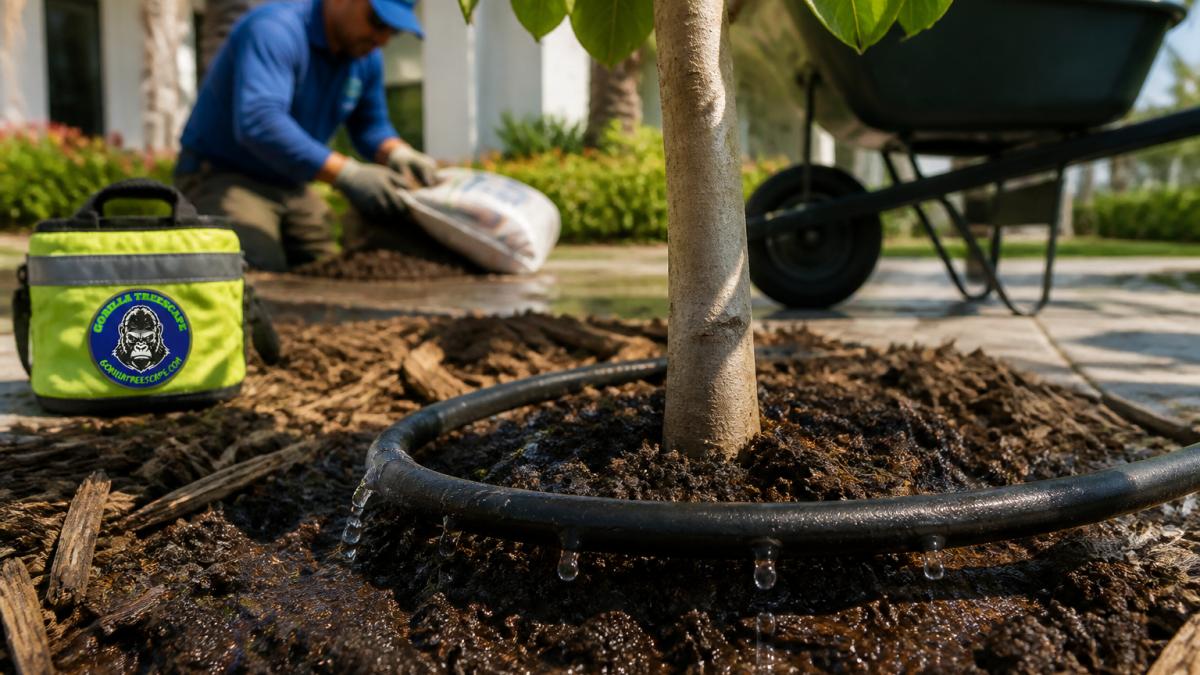
Use soaker hoses or drip irrigation to deliver water directly to the root zone. Overhead sprinklers waste water and promote fungal issues.
Mature trees need deep watering roughly once every 7-10 days during dry periods, wetting soil 12-18 inches deep.
Watch for drought stress: curled leaves, dull color, or early leaf drop. Supplement watering during hot, dry seasons.
Tip 3: Mulch and Protect Your Tree's Root Zone
Mulch regulates soil temperature, conserves moisture, and suppresses weeds competing for nutrients.
Apply 2-4 inches of organic mulch in a circle around the tree base. Extend it to the drip line, which is where the outer branches end. This is the active root zone where most water absorption happens.
Critical mistake: piling mulch against the trunk causes bark rot and pest problems. Keep mulch 6-12 inches from the trunk to allow air circulation.
Use wood chips, shredded bark, or composted leaves. Avoid dyed mulches and rubber products.
Refresh mulch annually as it decomposes, maintaining protective benefits without trunk contact.
Tip 4: Follow Tree Pruning Best Practices for Structure and Health
Proper pruning strengthens structure; improper pruning creates wounds that invite disease.
Young trees benefit from structural pruning: remove crossing or weak-angled branches and encourage a strong central leader and evenly spaced scaffold branches.
For mature trees, remove dead, diseased, or damaged branches first. Then thin crowded canopy to improve light and airflow, reducing disease pressure.
Follow these pruning limits:
- Never remove more than 25% of live branches in one year
- Avoid topping trees (cutting main branches to stubs)
- Make cuts just outside the branch collar, not flush with the trunk
- Prune in late winter or early spring when trees are dormant
Hire a certified arborist for branches larger than your thumb or work requiring climbing or power equipment.
Tip 5: Perform Regular Tree Health Inspections
Monthly inspections catch problems early. Learn to distinguish between cosmetic issues, treatable problems, and signs requiring professional diagnosis.
Common Pest and Disease Symptoms: What to Look For
Learn to identify these frequent issues so you know whether to monitor, treat, or call an arborist:
Leaf Damage and Discoloration
- Spots with yellow halos: Fungal leaf spot. Monitor and thin canopy for air circulation.
- Yellowing between veins: Possible nutrient deficiency or chlorosis. Consider soil testing.
- Holes or chewed edges: Insect feeding. Minor damage is usually tolerable; heavy defoliation warrants treatment.
- Premature leaf drop: Stress signal. Check soil moisture and inspect for root damage or cankers.
Bark and Trunk Issues
- Small holes with sawdust: Bark beetles or borers. Call an arborist promptly.
- Oozing or dark staining: Canker or bacterial wetwood. Monitor spread; remove if girdling.
- Peeling or missing bark: Sunscald, frost crack, or animal damage. Girdling damage kills the tree above; smaller wounds usually heal.
- Fungal fruiting bodies: Indicates internal decay. Have an arborist assess structural risk.
Root Zone and Structural Concerns
- Heaving roots or circling surface roots: Compaction or poor drainage. Aerate or improve drainage.
- New lean after a storm: May indicate root damage. Call an arborist.
- Large trunk cracks or weeping cracks: Suggest internal decay or structural failure. Seek professional assessment.
When to Monitor vs. When to Act
Monitor: Minor leaf spots, single dead branches, small bark damage, light insect feeding.
Treat: Dead branches, diseased branches with cankers, crowded canopy, mulch touching trunk.
Call an Arborist: Bark beetles or borers, girdling cankers, fungal fruiting bodies on major limbs, new lean or root heave, sudden decline, unidentified pests or disease.
Document and Track Changes
Take photos from multiple angles and note the date, location, and observations. Track whether issues spread or remain stable. This record helps arborists diagnose accurately and decide whether the tree can be saved.
When to Hire an Arborist: Know When Professional Help Is Needed
Knowing when to call an arborist prevents injury, property damage, and costly mistakes.
Tasks That Require a Professional Arborist
Hire a certified arborist for:
- Large branch removal (anything thicker than your wrist)
- Tree removal or emergency work after storms
- Diagnosis of pest or disease issues you cannot identify
- Crown reduction, cabling, bracing, or complex pruning
- Tree work near power lines, structures, or property lines
- Climbing work or use of power equipment
- Assessment of tree stability or structural defects
Chainsaws, climbing, and heavy branches cause thousands of injuries annually. Professional arborists carry liability insurance and use proper safety equipment.
What Makes an Arborist "Certified"?
The International Society of Arboriculture (ISA) offers the most widely recognized credential: ISA Certified Arborist. To earn this certification, an arborist must:
- Have at least three years of full-time work experience in arboriculture
- Pass a comprehensive exam covering tree biology, pruning, pest management, safety, and business practices
- Maintain the credential through continuing education (40 hours every three years)
ISA Certified Arborists have demonstrated knowledge and commit to staying current. Look for the ISA logo or ask to see the certificate.
Other credentials include ISA CAM (municipal trees), ISA CAU (utility work), and TRAQ (tree hazard assessment).
Questions to Ask Before Hiring
Get written estimates from at least two arborists. When you call or meet, ask:
- "Are you ISA Certified? Can you provide proof?" If not, ask about their training and years of experience.
- "Do you carry liability insurance and workers' compensation?" Request proof. This protects you if someone is injured or property is damaged.
- "What will you do with the debris?" (Chipping, hauling, grinding, etc.) Debris disposal is often a hidden cost. Confirm it's included in the estimate.
- "Can you provide three references from recent jobs?" Call them. Ask whether the work was completed on time, whether the property was cleaned up, and whether they'd hire the same company again.
- "Will you climb the tree or use a bucket truck?" Bucket trucks are safer and faster for large trees but cost more. Climbing is appropriate for smaller work.
- "Do you have a contract?" A written agreement should specify the work, timeline, cost, and what happens if the job takes longer than expected.
Red Flags: When NOT to Hire
Avoid arborists who:
- Recommend topping trees (cutting main branches to stubs). This is harmful and indicates poor training.
- Pressure you to remove healthy trees or perform unnecessary work.
- Quote significantly lower than other estimates without explaining why.
- Cannot provide proof of insurance or references.
- Offer to remove a tree and disappear without cleaning up debris.
- Use the term "tree surgeon" (outdated and not a regulated credential).
- Recommend treating every pest or disease with chemicals without discussing alternatives.
Understanding Tree-Care Safety
Power Lines: Only trained arborists should prune trees near power lines. Contact your utility company if a tree threatens lines.
Ladder Work: Hire a professional for ladder work, it's dangerous at height with tools.
Widow-Makers: Dead branches can fall without warning. Have them removed professionally.
Root Damage: Call an arborist before digging near trees to locate major roots.
Cost and Timeline Expectations
Tree work is not cheap, but it's an investment in safety and property value.
Get the estimate in writing.
When to Call an Arborist Immediately
Don't wait for a routine appointment if:
- A tree is leaning or has fallen
- Large branches hang over your house, power lines, or a neighbor's property
- The tree is obviously dead or dying
- You see bark beetles, borers, or other serious pests
- A tree is damaged after a storm and you're unsure of its stability
Many arborists offer emergency services 24/7 during storm season.
Seasonal Tree Care Calendar
Tree care needs shift with the seasons. This calendar keeps your trees healthy year-round.
Spring (March-May)
- Inspect for winter damage and remove dead branches
- Apply fresh mulch after soil warms
- Begin regular watering for new growth
- Watch for pests and disease as temperatures rise
Summer (June-August)
- Water deeply during heat and drought
- Monitor for pest activity and leaf damage
- Avoid major pruning (except removing dead branches)
- Keep mulch at proper depth as summer heat increases decomposition
Fall (September-November)
- Reduce watering as temperatures drop and rainfall increases
- Remove dead branches and thin canopy for winter wind resistance
- Plant new trees in early fall when temperatures moderate
- Rake leaves but leave some mulch protection around the root zone
Winter (December-February)
- Prune dormant trees when structure is visible (late winter preferred)
- Avoid pruning in extreme cold
- Protect young trees from snow and ice damage
- Plan spring tree work and order nursery trees early
Maintaining healthy residential trees protects your property investment and creates a safer, more beautiful outdoor space. The five essential tips for maintaining healthy residential trees, choosing the right species, watering properly, mulching correctly, pruning strategically, and inspecting regularly, form the foundation of long-term tree health.
When you need expert guidance or professional help with tree removal, emergency services, or complex pruning, Gorilla Treescape LLC brings certified expertise and reliable service to your landscape. Our team handles everything from routine maintenance to emergency response, and we also offer Landscaping & Pool Maintenance to keep your entire outdoor space in top condition. Get a quote today and let us help you build the outdoor space you've always wanted.
Frequently Asked Questions
How often should residential trees be inspected?
Inspect your trees at least twice yearly, once in spring and once in fall, to catch early signs of stress, disease, or structural issues. Young trees and recently planted trees benefit from monthly checks during their first year. After storms or extreme weather, inspect immediately for damage. Regular inspections help you identify problems before they become expensive to fix.
What are signs that a residential tree may be unhealthy?
Watch for yellowing or wilting leaves, bare branches in the canopy, oozing sap or bark damage, visible pest damage, fungal growth, or lean in the trunk. Slow growth, sparse foliage, or dead branches are also red flags. If you notice these signs, perform a closer tree health inspection or contact a certified arborist to diagnose the problem and recommend treatment.
How much water do newly planted trees need?
Newly planted trees need consistent moisture during their first year. Water deeply 2-3 times per week, delivering 1-2 inches per week depending on rainfall and soil drainage. Check soil moisture 2-3 inches below the surface, it should feel moist but not waterlogged. Reduce frequency as the root system establishes, but maintain steady watering during dry spells to prevent drought stress.
When should I call an arborist about a tree?
Contact a certified arborist if your tree shows signs of disease or pest damage, has large dead branches, leans significantly, or was damaged in a storm. Also call if you need professional pruning advice, staking guidance, or help with mature tree care. An arborist can diagnose problems you cannot identify and provide treatment plans that protect your tree's health and safety.