 how-to
Signs Your Trees Need Removal: 7 Warning Signs to Know
Table of Contents
- How to Assess Whether Your Trees Need Removal
- 7 Warning Signs Your Trees Need Removal
- When to Prune vs Remove a Tree
- Why Hiring a Certified Arborist Matters
- The Cost of Tree Removal and What Affects It
- Tree Species-Specific Vulnerability and Legal Considerations
- Post-Removal Care and Stump Grinding
- Frequently Asked Questions
Last Updated: September 10, 2026
How to Assess Whether Your Trees Need Removal
Knowing when your trees need removal is one of the hardest calls a homeowner faces, because the difference between a tree worth saving and one that poses a real hazard often comes down to details most people never notice until it is too late. We walk properties every week where a homeowner suspected nothing was wrong until a limb landed on a fence. The good news: you can screen most trees yourself in under ten minutes using the same criteria a professional uses.
A tree qualifies for removal when its structural integrity has failed or is failing, when it threatens people or property, or when disease has progressed past the point where treatment can save it. Everything below is a way of testing those three conditions.
The International Society of Arboriculture's tree risk assessment resources frames this as a risk equation: the likelihood of failure multiplied by the consequences. A dying tree in an open field is a landscaping problem. The same tree overhanging a driveway is a safety hazard.
The 10/20/30 Rule for Tree Risk
The 10/20/30 rule is a quick field test for spotting trees that need a closer look. It flags a tree when it has one dead branch larger than 10 centimeters in diameter, when 20 percent or more of the canopy is dead or missing, or when 30 percent of the trunk circumference shows damage or decay (isa-arbor.com).
Treat it as a screening tool, not a verdict. A tree that trips one of the three thresholds usually has years of useful life left; a tree that trips all three almost always needs professional evaluation. This rule is why we tell homeowners to measure rather than eyeball. A branch that looks "small" from the ground is often well past 10 centimeters.
DIY vs. Professional Risk Assessment
You can and should do a basic walkaround yourself. What you cannot do from the ground is assess internal decay, root plate stability, or the load-bearing capacity of a compromised trunk, and those are exactly the factors that decide whether a tree fails in a storm.
Here is how to split the work:
| Assessment Task | DIY | Professional |
|---|---|---|
| Visual inspection of canopy and trunk | Yes | Yes |
| Spotting fungal fruiting bodies or cankers | Yes | Yes |
| Measuring dead branch diameter | Yes | Yes |
| Root flare and root plate stability | No | Yes |
| Internal decay detection | No | Yes |
| Hazard assessment and removal planning | No | Yes |
If your walkaround turns up anything from the right column, stop and call a certified arborist.
7 Warning Signs Your Trees Need Removal
These seven signs cover the failures we see most often. Work through them in order; the earlier signs are easier to spot and the later ones are more serious.
1. Dead or Dying Branches
Deadwood is the most common early warning sign, and it is also the easiest to misread. A branch with no leaves in the growing season, brittle bark that snaps instead of bending, or a gray, peeling surface is dead or dying.
The danger is not the branch itself; it is where it falls. Dead branches over a driveway, patio, or walkway are a branch failure waiting for the next storm. Pruning can remove isolated deadwood on an otherwise healthy tree, but widespread dieback across the crown usually means the tree is declining from the inside.
2. Structural Damage and Cracks
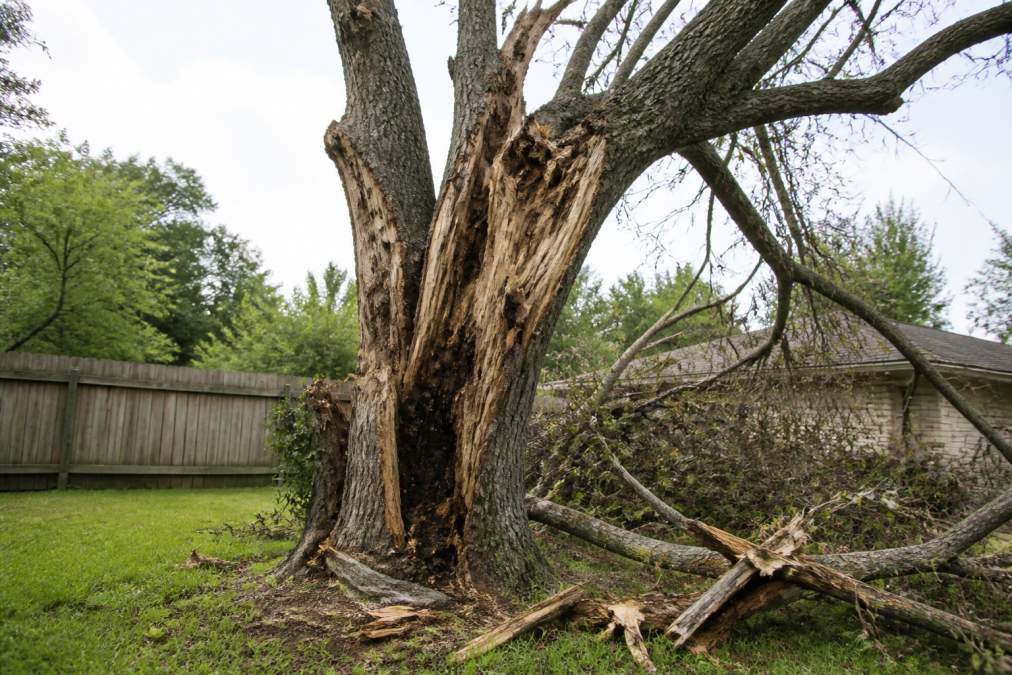
Cracks, bark splitting, and cavities in the trunk are signs that the tree's structural integrity is compromised. Look for vertical cracks running along the trunk, seams where bark has separated from the wood beneath, and any cavity deep enough to hold a finger.
A single shallow crack on an otherwise vigorous tree may only need monitoring. A crack that runs more than a third of the trunk's length, or one paired with a visible lean, is a removal conversation.
3. Root System Damage and Root Rot
Root damage is the hardest problem to see and the most dangerous to ignore, because a tree with a compromised root system can look perfectly healthy right up until it falls. Check the root flare at the base of the trunk; it should widen visibly where the trunk meets the soil.
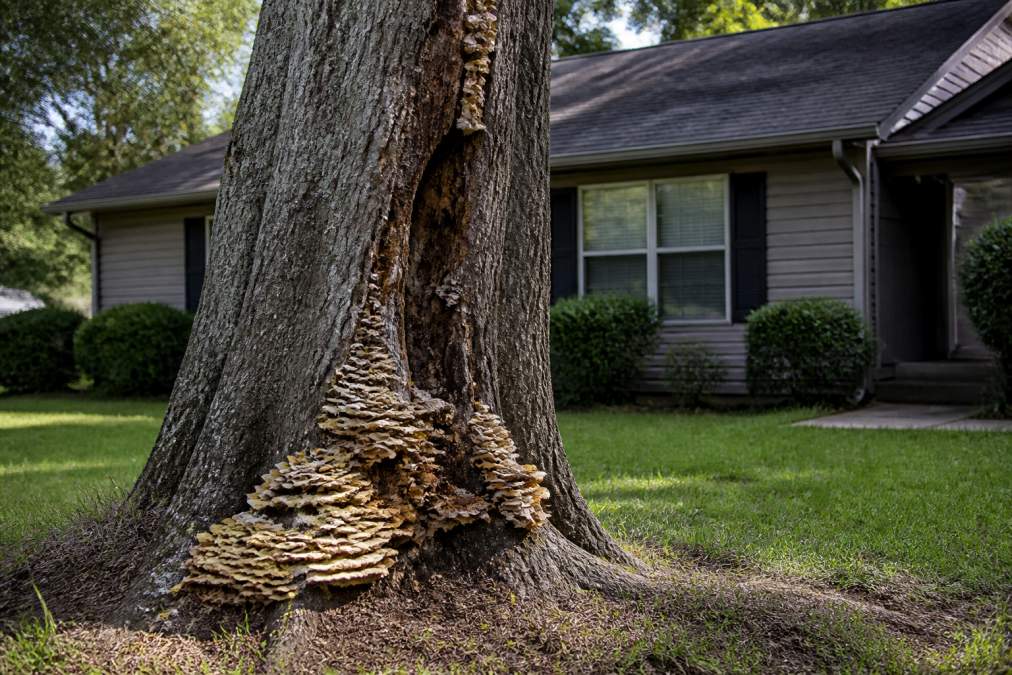
Warning signs include mushrooms growing at the base, soft or spongy soil around the trunk, a root flare that has sunk below grade, and exposed or severed roots from construction, trenching, or paving. Root rot rarely reverses. Once the anchoring roots are compromised, removal is usually the safer path.
4. Disease and Pest Infestation
Fungal fruiting bodies, cankers, and D-shaped exit holes are the three disease and pest signals that most often mean a tree is past saving. Fungal fruiting bodies are the shelf-like or mushroom-shaped growths on the trunk or at the base; by the time they appear, trunk decay is usually advanced.
Cankers are sunken, discolored lesions on branches or the trunk that girdle the tissue and cut off nutrient flow. D-shaped exit holes, roughly the size of a pencil lead, indicate wood-boring insects have already colonized the tree. Defoliation and foliage discoloration can have many causes, but when they appear alongside any of the above, the diagnosis is grim.
5. Proximity to Structures and Power Lines
A tree that is healthy but planted too close to a house, garage, or utility lines is a risk regardless of its condition. Branches within a few feet of a roofline will eventually drop debris onto it, and roots can crack foundations, lift driveways, and invade sewer lines.
Never prune anything within reach of a utility line yourself. That work belongs to the utility company or a qualified line-clearance professional. For trees crowding a structure, an arborist can often prune for clearance; if the trunk itself is within a few feet of the foundation, removal is usually the only real fix.
6. Leaning Trees and Storm Damage
A sudden lean is an emergency; a gradual lean may not be. Trees that have always grown at a slight angle are usually fine. A tree that has shifted noticeably since last season, especially after heavy rain or a storm, has likely lost root anchorage.
Storm damage adds a second layer of risk: cracked limbs still attached, split trunks, and uprooted root plates all create hazards that worsen with every weather event. If a tree has leaned more than a few degrees or shows a raised, cracked root plate, keep people and vehicles clear and get an assessment the same day.
7. Fungal Growth, Hollow Trunks, and Decay
Fungal growth on the trunk, a hollow sound when you tap the trunk with a mallet, and soft or crumbly wood are the classic trio of advanced decay. A hollow trunk does not automatically mean the tree is dead, but it does mean the tree has lost a significant share of its structural wood.
When to Prune vs Remove a Tree
Pruning is the right call when the tree's core structure is sound and the problem is limited to specific branches; removal is the right call when the trunk, root system, or overall health has failed. That is the whole decision in one sentence.
Prune when:
- Deadwood is isolated to a few branches
- Branches are crowding a roof or walkway but the trunk is sound
- The tree has a single crack or wound that is healing
- You want to improve shape, clearance, or light penetration
Remove when:
- More than a quarter of the canopy is dead
- The trunk has significant decay, cavities, or splitting
- The root system is damaged or the tree has leaned suddenly
- Disease or pest infestation has spread through the crown
A common mistake is pruning a declining tree to "save" it. If the decline is structural, pruning just delays the inevitable and adds cost.
Why Hiring a Certified Arborist Matters
Hiring a certified arborist matters because tree removal is one of the few home services where a wrong call can kill someone. An arborist certified through the International Society of Arboriculture's credentialing program has passed an exam on tree biology, risk assessment, and safe removal practice, and carries the insurance and equipment to do the work without putting your house, your neighbors, or your utility lines at risk.
What most homeowners miss is that the quote is not the whole cost. A low bid from an uninsured crew can become a five-figure liability if a limb lands on a car or a worker is injured on your property. Ask for proof of certification and insurance before anyone climbs.
The Cost of Tree Removal and What Affects It
There is no single price for tree removal; what you pay depends on the tree, the site, and the risk. Anyone quoting a flat number over the phone without seeing the property is guessing.
The factors that move the cost most:
- Size and height. Larger trees require more rigging, more equipment, and more time.
- Location. A tree in an open yard is straightforward; one overhanging a roof, pool, or power line requires careful rigging and often a crane.
- Condition. Dead, hollow, or leaning trees are more dangerous to remove and cost more.
- Access. Tight lots, fences, and landscaping that must be protected slow the work down.
- Stump removal. Grinding the stump and hauling debris is usually a separate line item.
- Emergency timing. Storm-damaged trees that must come down immediately carry a premium.
For an accurate number on your property, request a written quote after an on-site assessment. Gorilla Treescape LLC provides itemized quotes so you can see exactly what each part of the job involves.
Tree Species-Specific Vulnerability and Legal Considerations
Some species fail faster than others, and local rules sometimes decide whether you can remove a tree at all. Both factors are easy to overlook and both can change your plan.
Species with higher vulnerability to storm failure and decay include fast-growing varieties with weak wood, shallow-rooted species prone to uprooting in saturated soil, and trees that are common hosts for wood-boring insects. Slow-growing, deep-rooted hardwoods generally hold up better, though no species is immune to root rot or trunk decay.
On the legal side, many municipalities require a permit before removing a protected or heritage tree, and some require replacement plantings. Homeowners association covenants can add their own restrictions. Before scheduling removal, confirm the rules that apply to your property; a removal done without the required permit can result in fines and mandated replanting.
Post-Removal Care and Stump Grinding
Removing the tree is only half the job; what you do with the stump and the ground around it determines whether the space is usable again. Stump grinding removes the stump to below grade, which clears the way for sod, turf, or new plantings and eliminates the rot and pest habitat a leftover stump creates.
After grinding, the site needs the wood chips and debris cleared, the hole backfilled with topsoil, and the grade restored so water drains away from your foundation. If you plan to replant in the same spot, wait long enough for the old root system to decompose and for any soil pathogens to clear, or choose a species that is not vulnerable to the same disease.
This is also the moment to think about what replaces the tree. A new shade tree planted correctly, with proper spacing from the house and utilities, prevents the same problem twenty years from now.
Tree removal is stressful precisely because the decision is irreversible, and the warning signs that matter most are the ones you cannot see from the ground. If your walkaround turned up deadwood, cracks, fungal growth, or a lean, do not wait for the next storm to make the call for you. Gorilla Treescape LLC handles tree removal and post-removal care as part of a full property service, from on-site assessment and safe removal to stump grinding, grading, and replanting, with the project management that keeps the work moving. Get a quote and let our team assess your trees before the next hurricane season.
Frequently Asked Questions
How can you tell if a tree needs to be removed?
Look for dead branches, cracks in the trunk, fungal growth, root damage, and signs of disease or pest infestation. If a tree leans suddenly or has hollow areas, it may be a safety hazard. A certified arborist can confirm whether the tree can be saved or should be removed. In South Florida, storm damage often accelerates decline, so prompt assessment is key.
Does homeowners insurance cover tree removal?
Homeowners insurance typically covers tree removal if the tree falls on a covered structure, like your house or shed, or if it blocks a driveway or ramp. It usually does not cover removal for maintenance or disease. Check your policy for specific details. After a hurricane, many policies cover debris removal up to a certain limit. Always document damage with photos before filing a claim.
What is the 10/20/30 rule for trees?
The 10/20/30 rule is a guideline for tree risk assessment. It helps homeowners quickly identify potentially hazardous trees that may need removal.
Can a tree with root damage be saved?
Sometimes, if the damage is minor and caught early. But if major roots are severed or root rot is extensive, the tree may become unstable and need removal. Signs like mushrooms at the base, soft spots, or a sudden lean indicate serious root issues. A certified arborist can assess root health and recommend whether pruning, cabling, or removal is best.