 blog
Hardscaping Services Review: What to Expect
Table of Contents
- What Hardscaping Services Include
- Hardscaping Contractor Reviews: How to Evaluate
- Hardscape Design and Planning
- Hardscaping Estimate Checklist: What to Ask For
- Hardscape Project Timeline: Phases and Duration
- Questions to Ask a Hardscaping Contractor
- Material Selection, Durability, and Maintenance
- Budget, Permits, and Contract Terms
- Frequently Asked Questions
Last Updated: October 13, 2026
What Hardscaping Services Include
Hardscaping services cover the construction and installation of non-plant outdoor features that form your landscape's structural foundation, design, engineering, and material selection, not just patio placement.
At Gorilla Treescape LLC, we know hardscaping is the backbone of any outdoor living transformation.
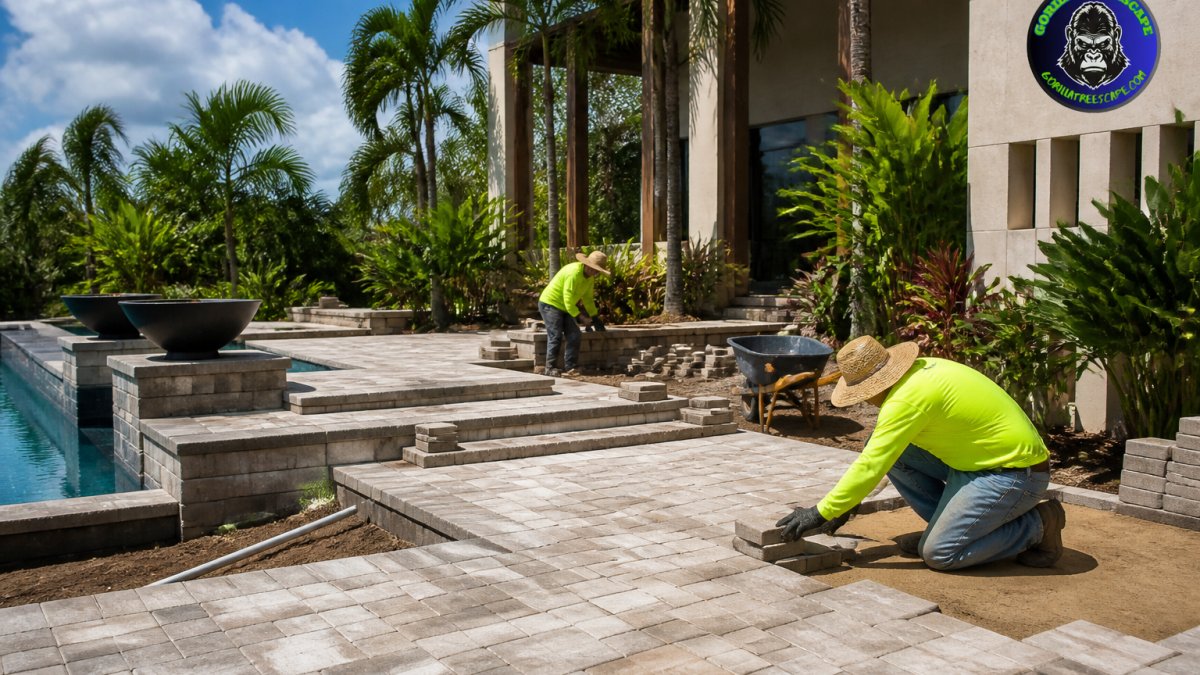
Professional hardscaping contractors handle site prep, grading, excavation, and structural installation, managing drainage and building lasting foundations, work requiring knowledge of local soil, weather, and building codes.
The difference between DIY and professional installation is durability.
Hardscaping Contractor Reviews: How to Evaluate
Star ratings tell you little about whether a hardscaping contractor shows up on time, builds a base that survives freeze-thaw, or honors a workmanship warranty two winters later. Treat reviews as a verification tool, not a popularity score.
Step 1: Separate the review source from the review content
Reviews fall into three tiers of reliability:
- Platform reviews (Google, Yelp, Angi, Houzz): Easy to solicit and game. Useful for volume and recency, weak on project detail.
- Trade and manufacturer directories: Certified installers passed manufacturer training, stronger than a five-star average.
- Direct references from completed jobs: The only source verifying scope, budget, and outcome. Ask for three from jobs completed 12-24 months ago.
Step 2: Score reviews on five dimensions
Grade each review on five criteria instead of star count:
- Project specificity, Does the reviewer name project type, size, and materials? Generic praise carries little weight.
- Recency, A cluster of five-star reviews from three years ago with nothing since is a yellow flag. Look for steady cadence across the last 12-18 months.
- Photo evidence, Before/after photos are harder to fabricate than text. Cross-check against the contractor's portfolio.
- Complaint patterns, not single complaints, One bad review is noise. The same complaint repeated ("disappeared mid-project," "joints settled after one winter") is disqualifying until explained.
- Post-project behavior, Reviews mentioning a callback for settling or warranty repair tell you more than the original install review.
Step 3: Verify the credentials behind the reviews
Reviews describe experience; credentials confirm it. Verify these on your state or local licensing portal and the contractor's COI:
- State or local license, Requirements vary by jurisdiction. Ask for the license number and verify it yourself, not via screenshot.
- General liability insurance, Request a certificate of insurance (COI) listing your address as the project location, then call the insurer to confirm it's active.
- Workers' compensation, If the contractor has employees, ask for proof of coverage. An uninsured worker injured on your property can trigger a claim on your homeowner's policy.
Step 4: Red flags that override a strong rating
Even a 4.8-star average shouldn't save a contractor who:
- Requests full payment or a deposit above roughly a third of the contract before any material is delivered.
- Cannot provide three references from projects completed in the last two years.
- Gives a verbal estimate only, or a written estimate with one lump-sum line and no itemization.
Step 5: Turn the review pass into a shortlist
End with three contractors who each pass the credential check, have three verifiable recent references, and show no repeating complaint pattern. That shortlist, not the highest-rated platform contractor, is what you take into the estimate and contract stage.
Verify a contractor's license and complaint history through your state licensing board
Hardscape Design and Planning
The hardscape design phase determines whether your outdoor space functions well and stays appealing for years. Services like Landscaping And Outdoor Living Design and Back Yard Design help homeowners translate their vision into a functional, durable plan tailored to their property and climate.
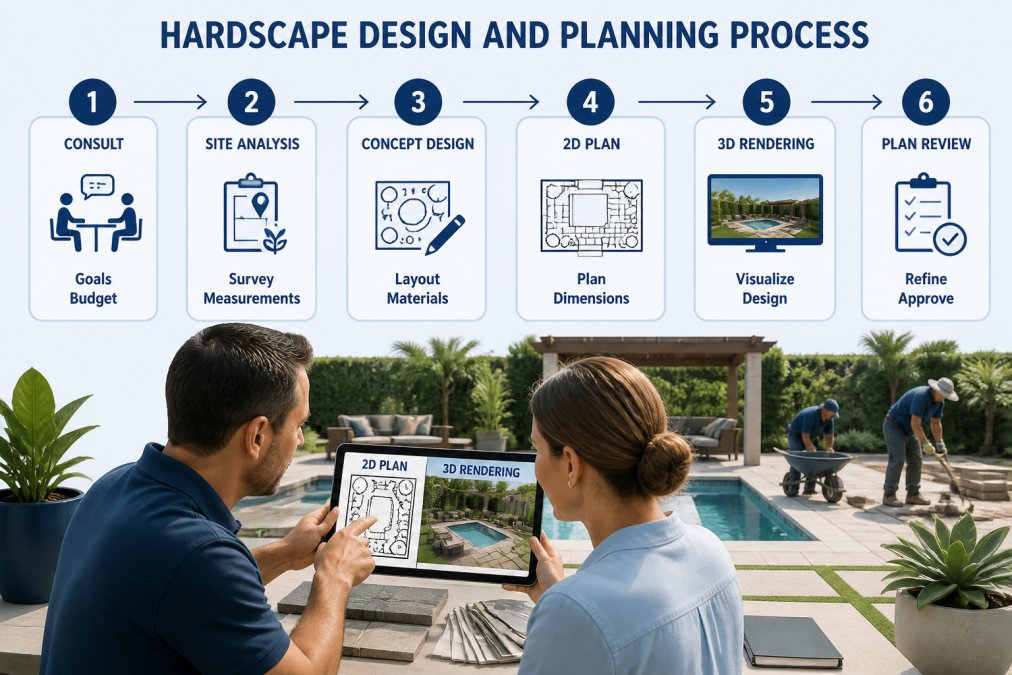
A quality hardscape design addresses drainage patterns, slope management, and water flow.
Design planning should include material selection based on climate durability, maintenance, and aesthetics.
Request 2D renderings or 3D visualizations before work begins. These show how material colors, layouts, and features will look in your actual space, helping you make informed design adjustments.
Hardscaping Estimate Checklist: What to Ask For
A comprehensive hardscaping estimate should itemize labor, materials, site preparation, permits, and timeline.
Request a breakdown covering excavation and grading, material pricing per unit, labor rates, equipment rental, waste removal, and permits or inspections.
Clarify what happens if excavation uncovers buried utilities, poor soil, or rock.
Ask whether drainage solutions are in the base estimate or charged separately, and whether removal and disposal of old hardscaping materials is included.
Hardscape Project Timeline: Phases and Duration
Understanding project phases helps you plan for disruption and set realistic expectations.
Site preparation usually takes several days of excavation, grading, and base installation, and is weather-dependent, rain can delay work significantly.
Installation varies by size and complexity: a small patio might take one to two weeks, while an outdoor kitchen with custom stonework could take four to eight weeks or longer.
Finishing work includes joint filling, sealing, cleanup, and landscaping restoration, often longer than homeowners expect, because details drive durability and appearance.
Weather significantly impacts timelines: rain delays excavation and concrete curing, and winter slows work in northern climates.
Questions to Ask a Hardscaping Contractor
Before hiring, ask about the contractor's experience with your specific project type and request references from projects similar in scope, not just their best work.
Verify licensing, liability insurance, and workers' compensation, and ask whether the contractor handles permits or you do.
Ask about warranty coverage: what the workmanship warranty covers, how long it lasts, and whether material warranties differ from labor.
Discuss communication expectations: how often you'll receive updates, your primary contact if issues arise, and whether the contractor provides progress photos.
Material Selection, Durability, and Maintenance
The materials you choose for hardscaping directly impact longevity, maintenance, and cost.
Natural stone, granite, limestone, slate, offers timeless appeal and excellent durability, typically lasting 20-30 years or longer with proper maintenance.
Concrete pavers offer versatility in color and pattern with good durability, lasting 15-25 years.
Stamped concrete mimics stone or brick at lower cost and is relatively low-maintenance, but can crack over time, especially in freeze-thaw climates.
Ask your contractor about durability in your specific climate, materials that perform well in warm, dry regions may struggle with freeze-thaw cycles or heavy moisture. Ongoing care is essential to protecting your investment, and services like Landscaping & Pool Maintenance can help keep your hardscape in top condition year-round.
Budget, Permits, and Contract Terms
This is where most hardscaping projects succeed or fail financially. Here's what to expect on paper before you sign.
What a real itemized estimate looks like
A lump-sum estimate is not an estimate, it is a number. A professional hardscaping estimate breaks the project into line items you can compare across contractors, including at minimum:
- Site preparation, Demolition and removal of existing hardscape, excavation, grading, and haul-away of spoils.
- Base and sub-base, Crushed stone, compacted aggregate, geotextile fabric, and bedding layer, listed by depth and square footage.
- Materials, Paver, stone, or concrete unit type, quantity, and price per square foot or unit.
If any line is missing, ask why. If the answer is "it's included," ask for it to be broken out anyway so you can compare apples to apples.
How to compare three estimates fairly
Normalize the three estimates before comparing totals:
- Same scope, same square footage. A 400 sq ft quote and a 500 sq ft quote are not comparable.
- Same material grade. Ask for manufacturer, product line, and thickness, a 60 mm paver and an 80 mm paver have different load ratings and prices.
- Same base depth. Ask for compacted base depth in inches. A patio on 4 inches and one on 6 inches are not the same product, even if the surface looks identical.
- Same drainage scope. Confirm whether each estimate includes drainage, and if so, what type and where it discharges.
- Same warranty terms. Compare workmanship warranty length and coverage, not just whether one exists.
Payment milestones: what is standard
A typical payment schedule:
- Deposit at signing: Commonly 10-30% of the contract total, covering material ordering and scheduling.
- Progress payment at material delivery or rough-in completion: Often 30-40%, released when materials are on site or excavation and base are complete.
- Progress payment at substantial completion: Often 20-30%, released when installation is finished and punch-list items are identified.
Be cautious of any schedule that front-loads more than about a third of the contract before materials are delivered, or asks for final payment before the punch list is closed.
Permits: when you need them and who pulls them
Permit requirements vary by jurisdiction, but the triggers are fairly consistent:
- Retaining walls above a threshold height, Many jurisdictions require a permit and sometimes engineered drawings once a wall exceeds roughly 3-4 feet from the bottom of the footing.
- Grading and drainage changes, Significant regrading or new drainage that alters stormwater flow often requires a grading permit.
- Structures with electrical or gas, Outdoor kitchens, fire features, and lighting typically require electrical and sometimes gas permits, plus inspection.
Ask each contractor whether they pull permits in their own name or expect you to. Contractors who routinely pull permits know local inspection requirements and are less likely to leave you with an unpermitted structure at resale.
Change orders: how unexpected conditions should be handled
Buried utilities, rock, unstable soil, and undocumented drainage are the four most common excavation surprises. A professional contract addresses them in advance:
- Written change order required before work proceeds. No verbal approvals. It should state the added scope, cost, and time.
- Unit pricing for common contingencies. Pre-price rock removal per cubic yard, soil replacement per cubic yard, and utility relocation per linear foot, so you're not negotiating under pressure mid-project.
- A stated contingency allowance. Often 10-15% of the project total, billed only if used and refunded if not.
Warranty terms: what to look for and what to expect
Hardscaping warranties come in two non-interchangeable layers:
- Workmanship warranty, Covers installation defects: settling, heaving, joint failure, poor drainage, and base failure. Typically 1-2 years, though some contractors offer longer. Ask what voids it, most require you to maintain drainage and not alter the installation.
- Material warranty, Covers the product itself: paver fading, cracking, or manufacturing defects. Issued by the manufacturer, not the contractor, and often runs 10 years to lifetime. Ask for the written manufacturer warranty, not a verbal summary.
Get both warranties in writing, along with the manufacturer's installation guidelines the contractor must follow. Deviating from those guidelines can void the material warranty, one more reason to confirm base depth and drainage scope before work begins.
Frequently Asked Questions
What is included in hardscaping services?
Hardscaping services encompass the non-plant elements of outdoor design and installation: patios, walkways, retaining walls, outdoor kitchens, fire features, drainage solutions, and structural elements. Professional hardscaping contractors handle site preparation, excavation, grading, material selection, structural installation, and workmanship. A full-service provider manages design consultation, 2D or 3D renderings, project planning, permit handling, and follow-up support to ensure your outdoor living space is both functional and durable.
What should a hardscaping estimate checklist include?
A comprehensive hardscaping estimate should itemize labor, materials, site preparation, excavation, grading, drainage solutions, structural installation, permits, timeline, warranty coverage, and change-order procedures. It should specify the scope of work, material grades and quantities, project phases, start and completion dates, payment schedule, and any follow-up maintenance or support included. Ask the contractor to clarify what happens if site conditions change, how extras are priced, and what warranty applies to workmanship and materials.
How long does a typical hardscape project take?
Hardscape project timelines vary by scope and complexity. Simple patios or walkways may take 1-3 weeks; larger projects with retaining walls, drainage systems, or outdoor kitchens often span 4-8 weeks or longer. Site preparation, weather, permit processing, and material availability affect duration. Before hiring, ask for a detailed project timeline that breaks down each phase: design, permitting, site prep, excavation, installation, and finishing work.
What questions should I ask before hiring a hardscaping contractor?
Ask about their experience with your specific project type, whether they handle permits and site drainage, their warranty on workmanship and materials, how they manage change orders, their communication process during the project, and for references from recent clients. Verify they're licensed and insured. Request a detailed written estimate, timeline, and contract terms. Ask how they handle unexpected site conditions, what happens if the project runs over budget or schedule, and whether they provide post-project maintenance recommendations or follow-up support.