 how-to
Preventing Landscape Construction Project Delays: 2026 Guide
Table of Contents
- What You'll Need Before Breaking Ground
- Landscape Construction Timeline Expectations: What a Realistic Schedule Looks Like
- Common Causes of Landscaping Project Delays (and How to Spot Them Early)
- Step 1: Lock Down Permits and Site Readiness Before Day One
- Step 2: How to Manage Landscaping Contractor Schedules Without Micromanaging
- Step 3: Build a Contingency Budget and Post-Delay Recovery Plan
- Contract Clauses and Client Responsibilities That Prevent Blowups
- Frequently Asked Questions
Last Updated: September 17, 2026
What You'll Need Before Breaking Ground
Preventing landscape construction project delays starts before the first shovel hits dirt. A realistic plan, approved permits, and a clear scope decide whether your build finishes on schedule or stalls for weeks.
- A signed contract with a defined scope. Every plant, paver, and pergola listed. Vague scopes invite change orders, and change orders are where schedules die.
- Approved permits. Do not let excavation start while paperwork sits in a municipal queue.
- A site assessment. Drainage, soil conditions, and utility locations all get checked before design is finalized.
- A realistic budget with a contingency line. Material prices move and weather happens; contingency absorbs both without stalling work.
- A single point of contact. One decision-maker on the client side prevents approval bottlenecks that quietly add days.
Landscape Construction Timeline Expectations: What a Realistic Schedule Looks Like
A typical backyard build with a pool, patio, and planting runs several months from design sign-off to final walkthrough, depending on permit turnaround and material lead times. Many homeowners underestimate the front end: design revisions, HOA approvals, and municipal permits can consume a large share of the timeline before construction begins. Treating permitting as a formality rather than a phase with its own duration is a common mistake.
Phase-by-Phase Breakdown for a Typical Backyard Build
| Phase | Typical Duration | What Happens |
|---|---|---|
| Design and planning | Several weeks | Concept, revisions, material selections |
| Permitting and HOA approval | Weeks to a few months | Plan review, inspections scheduled |
| Site prep and excavation | Days to weeks | Clearing, grading, utility marking |
| Hardscape and pool shell | Weeks | Patio, deck, pool structure |
| Planting and finishing | Weeks | Sod, garden install, cleanup |
Treat this as a framework, not a promise. Site conditions, weather, and inspection scheduling all shift the numbers.
Common Causes of Landscaping Project Delays (and How to Spot Them Early)
Most landscaping project delays trace back to four sources: weather, permits, supply chain, and coordination. Each gives off warning signs long before it becomes a crisis.
Weather, Permits, and Supply Chain Bottlenecks
Weather mitigation is planning, not reaction. In South Florida, afternoon storms and hurricane season wipe out excavation days, so front-load outdoor work into drier windows and keep indoor-adjacent tasks as backups. Permits are the second bottleneck: incomplete submittals get kicked back, and each revision cycle costs time. Material procurement is the third, specialty plants, imported stone, and custom pool finishes carry long lead times that surprise homeowners who assume everything is in stock.
Spot these early by asking three questions before work starts:
- What's the current permit status, and who owns the next action?
- Which materials have lead times longer than two weeks?
- What's the weather contingency plan for the next 30 days?
Step 1: Lock Down Permits and Site Readiness Before Day One
Gorilla Treescape LLC handles permit work for projects in less than two months, removing a common early-stage stall for homeowners who don't want to manage municipal paperwork.
Step 2: How to Manage Landscaping Contractor Schedules Without Micromanaging
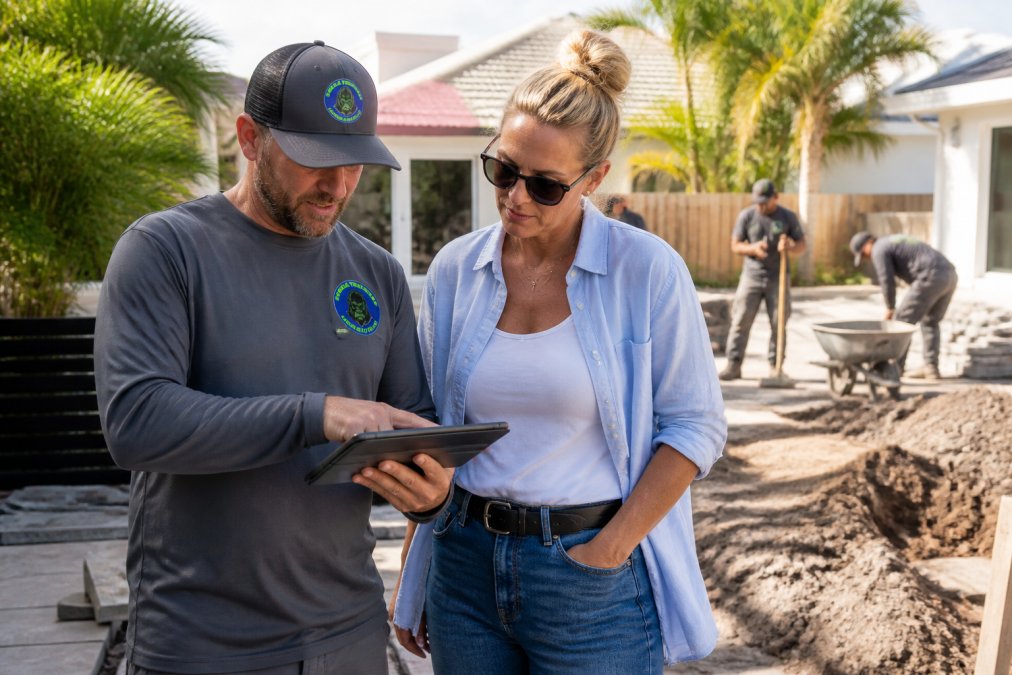
Managing a contractor schedule works best with rhythm, not surveillance. Agree on a weekly update cadence, a shared schedule document, and a clear escalation path, then let the crew work.
Subcontractor Coordination and Communication Rhythms
Subcontractor coordination is where most schedules hold or fall apart. Electricians, plumbers, pool crews, and planting teams must sequence correctly, one missed handoff cascades.
Set three rhythms and stick to them:
- A Monday kickoff message listing the week's milestones and any dependencies.
- A midweek check on material deliveries and equipment downtime.
- A Friday summary noting what finished, what slipped, and what changes next week.
Step 3: Build a Contingency Budget and Post-Delay Recovery Plan
A contingency budget of 10 to 15 percent of project cost is a common starting point, and a written recovery plan turns a delay from a crisis into a scheduling problem. Both belong in the contract, not a verbal understanding. This section gives you the actual recovery workflow to run when a delay has already happened.
How to Size a Contingency Line Without Overpaying
Contingency is not a slush fund, it is a priced allowance for known unknowns. Size it by listing every line item with a lead time longer than two weeks, every task depending on a municipal inspection, and every material whose price moves seasonally. Add a percentage on top of those exposed items rather than the whole project. A build with few long-lead items and no structural work can carry a smaller contingency than one with a pool shell, imported stone, or custom fabrication.
The Post-Delay Recovery Workflow
When a delay hits, run this sequence in order. Skipping steps is how a two-day slip becomes a two-week slip.
- Log the delay the day it happens. Record the date, task affected, cause, and who owns the next action. An unwritten delay cannot be recovered because no one agrees on when it started.
- Classify the cause. Weather, permit, supply, labor, or client decision. The classification determines which contract clause applies and whether the schedule date moves or the work resequences.
- Re-baseline the critical path. Identify which downstream tasks actually depend on the delayed item and which only appeared to. Many tasks can float without affecting the finish date.
- Triage into three buckets. Tasks that can run in parallel now, tasks that can be resequenced ahead of the delayed item, and tasks that are genuinely blocked. Only the third bucket extends the schedule.
- Compress where it is safe. Adding crew, extending hours, or overlapping trades can recover days, but only where quality and inspection requirements allow it. Compressing the wrong task creates rework that costs more time than it saves.
- Notify in writing. Most contracts require notice within a set window for a delay to be treated as excusable. Miss the window and the delay may default to the contractor's responsibility regardless of cause.
- Update the payment schedule. If a milestone payment was tied to the delayed task, the contract should state how it shifts. Cash flow stalls are a common second-order delay.
Contract Language That Makes Recovery Enforceable
A recovery plan is only as good as the clauses behind it. At minimum, the contract should address:
- Excusable delay events, named causes (weather, permit backlog, material shortage, utility conflict) that extend the schedule without penalty, plus the notice window required to claim them.
- Notice requirements, how many days each party has to report a delay in writing, and to whom.
- Schedule adjustment mechanism, how the finish date is formally moved, and who signs off.
- Cost responsibility, which party absorbs extended overhead, equipment rental, or re-mobilization costs for each delay category.
- Dispute path, the step-by-step process if the two sides disagree on whether a delay was excusable.
Contract Clauses and Client Responsibilities That Prevent Blowups
Contractual obligations cut both ways, and the client side is where many projects quietly lose time. Fast approvals, clear decisions, and prompt payments keep a schedule intact. Below are the clause-by-clause mechanisms behind each protection, plus the client-side duties most homeowners never see written down until they cause a delay.
The Clauses That Actually Prevent Delays
Delay provisions. These name the events that excuse a schedule slip, weather, permit backlog, material shortage, utility conflicts, and set a notification window. A delay clause without a notice requirement is unenforceable in practice because neither party can prove when the delay was reported. A common pattern is a 48-to-72-hour written notice window; miss it and the delay defaults to the responsible party.
Client-Side Responsibilities That Prevent Delays
- Respond to approvals within an agreed window. Design revisions, material selections, and finish choices gate the next phase. A common pattern is a 5-business-day response window in the contract. Miss it and the schedule slips while the crew may be reassigned to another job.
- Keep the site accessible during working hours. Locked gates, parked cars, and pets in the work zone cost real hours. If access is limited to certain hours, state it in the contract so the schedule accounts for it.
- Secure HOA approvals early. Architectural review boards can take weeks and often have their own submission windows. If the community requires approval, file it before the contractor mobilizes, not after.
- Make decisions once. Changing a material selection after it is ordered triggers restocking fees, return shipping, and a new lead time. The cheapest decision is the one made before the order is placed.
- Raise concerns immediately. A concern raised at the rough-in stage is a change order. The same concern raised at the final walkthrough is a rebuild.
- Keep the contingency funded. If the client controls the contingency line, it must be available when the first unexpected cost appears. A contingency requiring new loan approval is not a contingency.
The Federal Trade Commission's guidance on consumer contracts reinforces a principle worth applying here: clear written terms protect both parties when something goes wrong. For projects involving structural work, your local building department's permit requirements should be checked directly, since requirements vary by jurisdiction.
Frequently Asked Questions
How to prevent delays in landscape construction projects?
Start with a detailed schedule that maps every phase from permit acquisition to final inspection. Confirm site readiness before crews arrive, order materials early to avoid procurement gaps, and build a contingency budget for weather days. Regular milestone tracking and written change orders keep small issues from becoming major landscape construction delays. A pre-construction meeting with your contractor to review the critical path is the single highest-impact step.
What are considered excusable delays in construction?
Excusable delays typically include severe weather, permit office backlogs, utility conflicts discovered during site inspection, and supplier failures outside the contractor's control. These are usually defined in your contract's force majeure or delay clause. In South Florida, hurricane-related stoppages and permitting holds are common examples. Review your agreement to confirm which events qualify and what documentation you need to submit within the notice period.
How do weather conditions impact landscaping project timelines?
Heavy rain saturates soil and halts excavation, grading, and concrete work. In South Florida, afternoon storms during summer can cost several hours per week, and hurricane season may shut sites down for days. Build weather mitigation into your schedule by front-loading drainage and grading work, and keep indoor or covered tasks like pergola assembly ready as backup activities. Tracking weather days separately from contractor-caused delays keeps expectations clear.
What documentation is needed to keep a landscape project on schedule?
Keep a project binder with the signed contract, approved drawings, permit copies, change orders, daily logs, and photo documentation of each phase. Milestone tracking sheets and meeting notes create a paper trail if disputes arise. For post-delay recovery, document the cause, duration, and recovery steps in writing. This record also supports warranty claims and helps your contractor manage subcontractor coordination more effectively.