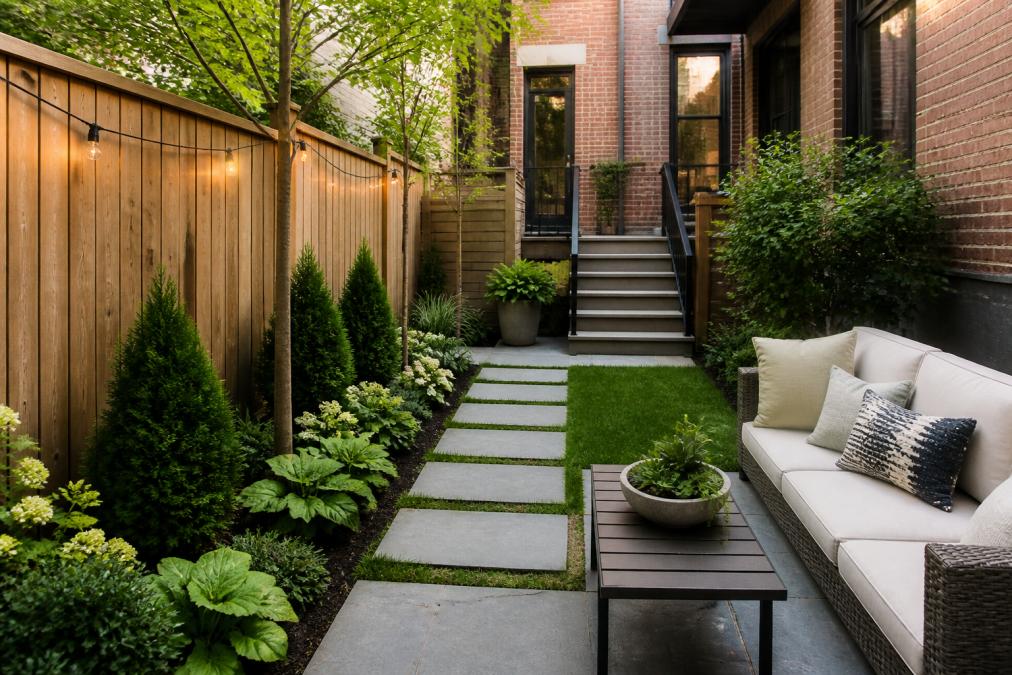
 how-to
Landscaping for Small Townhouse Backyards in 2026
Table of Contents
- Why Small Townhouse Backyards Need a Different Approach
- Step 1: Plan Your Space and Check HOA Rules First
- Step 2: Low Maintenance Garden Design Ideas That Work in Tight Spots
- Step 3: Privacy Screen Ideas for Small Backyards
- Step 4: Vertical Gardening for Townhouses to Maximize Every Foot
- Step 5: Choose Patio Materials and Lighting That Expand the View
- DIY vs. Hiring a Professional Landscaper
- Your Maintenance Schedule for a Small Backyard
- Frequently Asked Questions
Last Updated: September 9, 2026
Why Small Townhouse Backyards Need a Different Approach
Landscaping for small townhouse backyards fails more often than it succeeds, and the reason has little to do with the size of the space. Townhouse gardens come with unique constraints: shared walls, strict HOA covenants, narrow footprints, and limited access for heavy equipment. Applying a standard suburban playbook to a 15-foot-wide strip is a recipe for frustration and wasted money.
Homeowners who end up with a backyard they actually use treat the space as an outdoor room, not a miniature estate. They plan for zoning, privacy, and drainage before picking a plant or paver.
A compact courtyard can deliver more visual interest per square foot than a sprawling lawn, provided you follow a deliberate process. This guide covers HOA compliance, low-maintenance planting, privacy screens, vertical gardening, and materials that make small spaces feel larger.
Step 1: Plan Your Space and Check HOA Rules First
The single most common mistake in landscaping for small townhouse backyards is skipping the paperwork. Before you sketch a single bed or order a single plant, request your HOA’s architectural review guidelines. Many communities require written approval for any change to hardscaping, fencing, or even specific plant species. American Planning Association guidance on residential design standards notes that community covenants frequently dictate everything from fence height to allowable paving materials.
Start with a measured site plan. Note the exact dimensions, utility access points, and sunlight direction. This phase determines what will thrive and where you can place seating without blocking a walkway.
Key questions to answer before spending a dollar:
- What is the maximum permitted fence or screen height?
- Are there restrictions on artificial turf, pavers, or decomposed granite?
- Which plant species are on the HOA’s prohibited list?
- Where are the property lines, and do you need a setback from them?
HOA compliance is not optional. A violation can trigger fines, forced removal of installed features, and friction with neighbors you share a wall with. Getting approval in writing protects your investment.
Step 2: Low Maintenance Garden Design Ideas That Work in Tight Spots
Low maintenance garden design ideas for a townhouse backyard should prioritize structure over fussy planting. The goal is a space that looks intentional with minimal upkeep, which means choosing the right plants and reducing lawn. But the design must also solve for a narrow, rectangular footprint that serves as both a walkway and a gathering space.
A common approach is to eliminate grass in favor of hardscaping and drought-tolerant beds. Group plants with similar water needs to irrigate efficiently. Native and drought-tolerant species reduce your water bill and survive the heat with less attention.
Lay down a thick layer of mulch or decomposed granite to suppress weeds and retain moisture. Choose a few structural anchor plants, like a small specimen tree or ornamental grass, and repeat them rather than cramming in dozens of varieties. Repetition creates cohesion and makes the space feel larger.
The Unique Angle: Zoning by Function, Not Just Aesthetics
Most generic advice stops at plant selection. The real challenge is that the backyard is a multi-purpose room: a passageway to the alley, a dining area, a storage zone for trash bins, and a place to let the dog out. A low-maintenance design must assign a clear function to every linear foot.
Start by dividing the space into three zones along its length:
-
The Threshold Zone (0-3 feet from the house): This is the transition area. Use a hard surface like large-format pavers or a concrete pad that requires zero maintenance. Keep this zone clear of planters that would obstruct foot traffic. A single, low-profile bench or a slim water feature can anchor this area without creating clutter.
-
The Living Zone (3-10 feet from the house): This is the primary seating and dining area. The ground should be a stable, permeable surface such as decomposed granite or compacted gravel, which drains well and needs no mowing. Define the edges of this zone with raised planting beds made of metal or concrete, materials that do not rot or need painting. This is where you place a bistro set or a compact outdoor sofa.
-
The Utility Zone (10 feet to the fence): This is the workhorse area for trash cans, a hose bib, and potentially a small storage shed. Screen this zone with a fast-growing, clumping bamboo (check HOA rules first) or a simple vertical trellis with a climbing evergreen like star jasmine. This zone should be invisible from the house, which means it requires the most deliberate planning.
Plant Selection That Survives the Heat and the Neglect
For the planting beds, choose a palette of three to five species proven in your region. In the arid Southwest, that might be 'Blue Chalksticks' (Senecio mandraliscae), 'Desert Museum' palo verde (if space allows), and red yucca (Hesperaloe parviflora). In the humid Southeast, a better mix would be dwarf mondo grass, 'Evergreen Giant' liriope, and oakleaf hydrangea. In the Pacific Northwest, consider sword ferns, heucheras, and a single Japanese maple.
The mechanism for low maintenance is not just choosing tough plants, it is choosing plants that do not need dividing, staking, or deadheading. Avoid aggressive spreaders like mint or bamboo (unless clumping) and plants prone to powdery mildew. A common professional pattern is the 70/30 rule: 70% evergreen structure (shrubs, grasses, groundcovers) and 30% seasonal interest (perennials or bulbs).
The Drainage and Irrigation Mechanism
A low-maintenance design fails if water pools on the patio or the irrigation is a tangle of hoses. Install a single, automated drip line with a smart controller that adjusts for rainfall, running a dedicated line to each planting bed. Ensure the grade slopes away from the house at least 1/4 inch per foot. Decomposed granite must be compacted in layers with a mechanical plate compactor, or it will rut and wash away.
A well-executed low-maintenance plan is not about doing less work, it is about doing the right work once. By zoning the space, choosing regionally appropriate plants, and installing proper irrigation and drainage, you create a backyard that survives busy weeks and still looks intentional.
Step 3: Privacy Screen Ideas for Small Backyards
Privacy screen ideas for small backyards come down to a trade-off between speed, cost, and permanence. In a townhouse, you are often looking directly into a neighbor’s windows, and the solution must work within HOA height limits.
The fastest fix is a row of tall potted plants or ornamental grasses along the property line, creating a soft, movable screen. For a more solid solution, consider lattice panels on a simple frame, which support climbing vines and create a green wall over time while staying within typical fence height limits.
If you have the budget and HOA approval, a freestanding privacy screen or dense evergreen shrubs offer the most reliable seclusion. Hedges take time to fill in, while a fence gives instant privacy. Many homeowners combine both: a structural screen for immediate coverage and climbing plants to soften it.
Step 4: Vertical Gardening for Townhouses to Maximize Every Foot
Vertical gardening for townhouses is the single highest-impact strategy for a narrow backyard. When the ground footprint is only a few hundred square feet, the only direction left to grow is up. Wall-mounted planters, trellises, and living green walls turn bare fences into productive space.
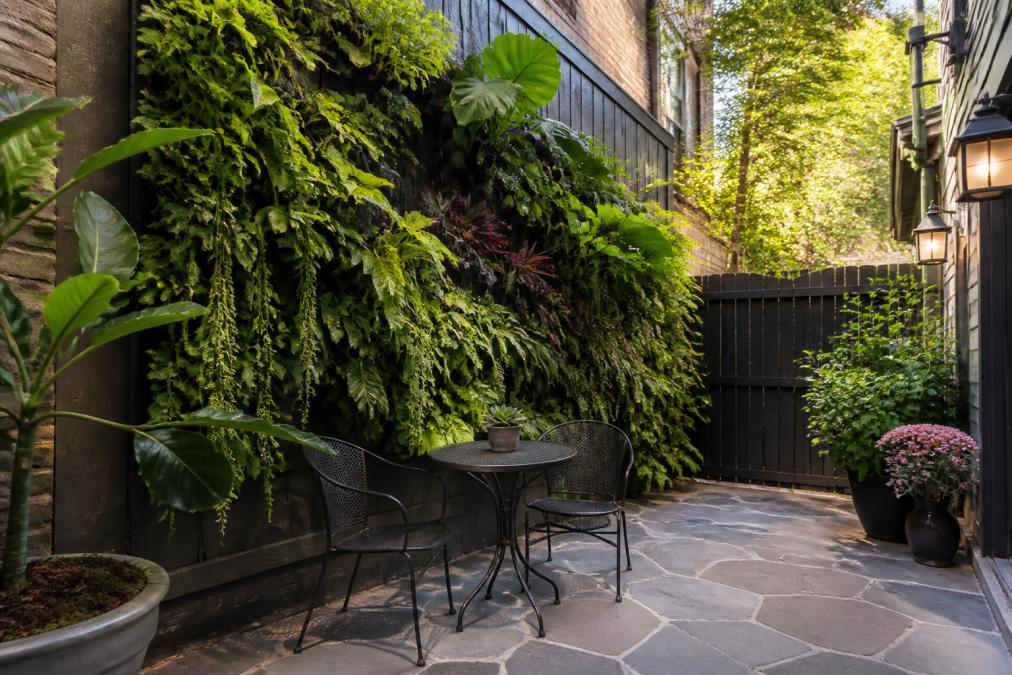
Start by assessing which walls receive the most sun. A south or west-facing wall is ideal for edibles and sun-loving ornamentals, while a north-facing wall suits shade-loving ferns. Install drip irrigation on the vertical planter so you are not hand-watering every pocket of soil.
The benefits go beyond aesthetics. A green wall adds insulation, reduces the heat island effect of a paved courtyard, and increases the sense of enclosure and calm. For townhouse living, a vertical garden is often the difference between a backyard that feels like an alley and one that feels like a private oasis.
Consider a mix of trailing plants, upright specimens, and compact edibles. This creates visual depth and interest at eye level and above, drawing the eye upward and making the footprint feel taller.
Step 5: Choose Patio Materials and Lighting That Expand the View
The materials you choose for the ground plane dictate the entire feel of the space. Large-format pavers or flagstone create fewer grout lines, tricking the eye into seeing a larger surface. Decomposed granite is a budget-friendly alternative that drains well, though it requires edging to keep it contained.
Stick to a consistent color palette across hardscaping and furniture. Too many competing materials fragment a small space. A unified tone for pavers, retaining walls, and planters creates a seamless flow that makes the courtyard feel more expansive.
Lighting is the second half of this equation. Ambient lighting extends usable hours and adds safety for steps and changes in elevation. Low-voltage path lights, uplights on a specimen tree, and string lights overhead create depth and draw the eye to the edges, making boundaries feel less confining.
DIY vs. Hiring a Professional Landscaper
The decision to tackle landscaping for small townhouse backyards yourself or hire a professional comes down to three factors: the scope of hardscaping, your drainage situation, and your tolerance for delays. But there is a fourth, often overlooked factor: access. Unlike a single-family home with a side gate, a townhouse backyard is often only accessible through the house or a narrow alley. This constraint can double the cost of any project requiring heavy materials.
The Unique Angle: The Cost-Benefit of Access and Permits
Before you decide, measure the width of your access path. If a wheelbarrow cannot fit through your back door or alley gate, any project involving bulk materials, gravel, pavers, concrete, or large plants, will require hand-carrying every item. This is where DIY savings evaporate. A professional crew brings the labor to move materials; a DIY homeowner may spend an entire weekend just hauling bags of decomposed granite.
What DIY is Viable For (and What It Really Costs)
DIY is viable for softscaping tasks: planting beds, installing a vertical garden, laying mulch, and setting up container gardening. These are weekend projects requiring no heavy equipment and carrying low risk. The cost savings are real, but the timeline stretches out, and a mistake in plant placement can take a season to correct.
For a typical 15x20-foot townhouse backyard, a DIY softscaping project (plants, mulch, edging, and a simple drip system) might cost in materials. Budget for at least three full weekends of work. The risk is not financial, it is the opportunity cost of your time and the possibility of plant failure due to poor placement or soil preparation.
When Professional Installation is Not Optional
Professional installation earns its keep when the project involves grading, drainage correction, retaining walls, or significant hardscaping. A patio that slopes toward the house foundation, or a drainage problem that floods the lawn after every storm, is not a DIY fix. EPA guidance on managing stormwater with green infrastructure highlights how proper grading and permeable surfaces prevent the kind of water damage that plagues poorly planned backyards. Getting this wrong the first time means paying twice to fix it.
The Hidden Cost: HOA Approval and Permit Handling
Many townhouse communities require architectural review for any hardscape change. A professional landscaping company will already know the local HOA submission process, fence height limits, and setback distances, as well as which permits are required for electrical or structural changes. A DIY homeowner often discovers these requirements only after the work is done, leading to fines or forced removal.
The Hybrid Approach and How to Budget It
Many townhouse owners find a hybrid approach works best. They handle planting and styling while hiring a professional for structural work, permit handling, and drainage. A common budget split is 60% for professional hardscaping and 40% for DIY softscaping. For example, you might hire a professional to install a 200-square-foot paver patio and a drainage channel (pricing depends on materials and access), while you handle planting beds, mulch, and container selection.
This is where Gorilla Treescape LLC fits. Our team specializes in navigating tight spaces, handling permits, and executing modern garden designs that respect HOA constraints, with seamless project management from concept to completion. We provide a detailed quote that separates structural work from planting so you can see where your DIY effort will save money and where it will cost you more.
Your Maintenance Schedule for a Small Backyard
A well-designed small backyard should not demand more than a few hours of maintenance per month. The schedule below assumes you have followed the low-maintenance principles from earlier: minimal lawn, drought-tolerant plants, and a solid layer of mulch.
| Task | Frequency | Best Season |
|---|---|---|
| Prune shrubs and ornamental grasses | Monthly during growing season | Spring through Fall |
| Check and clear drainage grates | Monthly | Year-round |
| Refresh mulch or decomposed granite | Twice per year | Spring and Fall |
| Fertilize container plants | Every 6-8 weeks | Spring and Summer |
| Trim vertical garden and vines | Every 2-3 weeks | Growing season |
| Power-wash patio pavers | Once per year | Spring |
| Inspect irrigation system | Quarterly | Year-round |
The key to a low-maintenance schedule is consistency. A 15-minute walk-through every week to pull weeds and check for issues prevents the backlog that turns a tidy courtyard into an overgrown mess.
For the more demanding tasks, like seasonal pruning of specimen trees or correcting a drainage issue that has resurfaced, a professional touch saves time and prevents damage. University extension service guidance on landscape maintenance recommends annual inspections of trees and hardscaping to catch small problems before they become costly repairs.
Landscaping for small townhouse backyards is a discipline of restraint and planning. The spaces that impress are not the ones with the most plants, but the ones where every element has a purpose and the maintenance load is manageable. If you are ready to transform your compact courtyard into a functional outdoor living space, the team at Gorilla Treescape LLC can handle everything from initial spatial planning to final installation, including permit handling and modern garden design. Get a quote today and see how your small townhouse backyard can become the best room in your home.
Frequently Asked Questions
How do you landscape a small townhouse backyard on a budget?
Start with a clear plan that zones the space for dining, lounging, and planting. Use decomposed granite or patio pavers for a low-cost, high-impact patio base. Focus on container gardening and vertical planting to avoid expensive grading work. Choose a few specimen plants instead of many small ones. If you are doing the work yourself, tackle hardscaping first and add plants gradually. For larger projects like drainage fixes or retaining walls, get a quote from a professional to avoid costly mistakes.
Do I need HOA approval for backyard landscaping in a townhouse?
Yes, most townhouse communities require HOA approval before you change hardscaping, add structures like pergolas or privacy screens, or alter drainage. Submit your landscape design plan, including materials and plant lists, before starting work. Check your HOA rules for restrictions on fence heights, plant species, and paved surfaces. Getting approval first prevents fines and the cost of removing unapproved work. A professional landscaping company can prepare the documentation your HOA needs.
What are the best low-maintenance plants for small townhouse gardens?
Drought-tolerant and shade-loving plants cut down on watering and pruning. Ornamental grasses, dwarf shrubs, and succulents work well in sunny spots. For shaded areas near fences, choose ferns and hostas. Native plants are a smart choice because they tolerate local weather and need less care once established. Pair them with a drip irrigation system on a timer to handle watering. This approach keeps your garden looking full without demanding hours of weekend maintenance.
How do I make a small townhouse backyard feel bigger?
Use a single material for the patio surface to create a continuous flow. Add a meandering path to draw the eye through the space. Keep furniture proportional to the footprint and choose light colors for walls and paving. Vertical planting draws the eye upward, making the area feel taller. Install ambient lighting to extend the space visually into the evening. Avoid clutter: a few large planters beat many small decorations.