 blog
blog
Best Landscape Design for Curb Appeal: 2026 Guide
Table of Contents
- Why Curb Appeal Still Drives Property Value in 2026
- Hardscaping vs Softscaping for Curb Appeal: What to Prioritize
- Best Plants for Front Yard Curb Appeal in a Hot, Humid Climate
- Low Maintenance Garden Design Ideas That Still Look Expensive
- Walkways, Edging, and Entry Paths: The Details That Sell the Look
- Lighting, Containers, and Privacy Screening for Year-Round Impact
- Budget Tiers, Maintenance Time, and Matching Your Home's Architecture
- Frequently Asked Questions
Last Updated: September 20, 2026
Why Curb Appeal Still Drives Property Value in 2026
Landscape design for curb appeal is the practice of shaping a home's front yard, entry, and visible perimeter so the property looks intentional, well-kept, and welcoming from the street. It combines hardscaping, softscaping, lighting, and maintenance into one first impression. At Gorilla Treescape LLC, we see the same pattern on nearly every South Florida consultation: buyers and appraisers form an opinion before they reach the front door.
That opinion carries real weight. A front yard that reads as finished signals a home that has been cared for, shaping perceived value and negotiation. A yard that reads as unfinished invites doubt about everything behind the walls.
Below, we break down the best landscape design for curb appeal by element, climate, budget, and upkeep, so you can plan a front yard that holds up through hurricane season and still looks sharp in February.
Hardscaping vs Softscaping for Curb Appeal: What to Prioritize
Hardscaping is the built, non-living part of a landscape: walkways, driveways, walls, edging, patios, and steps. Softscaping is everything that grows: trees, shrubs, perennials, ground cover, and lawn. For curb appeal, hardscaping comes first because it defines the lines and scale that softscaping fills in.
A common mistake is spending the entire budget on plants before the walkway, edging, and bed lines are resolved. Plants shift, spread, and die back; hardscape lines stay put and set the geometry the eye reads from the street.
Here is how the two compare when you are deciding where the money goes first:
| Element | Type | Curb Appeal Role | Priority |
|---|---|---|---|
| Paver walkway and entry path | Hardscape | Guides the eye to the door | First |
| Bed edging and border lines | Hardscape | Creates clean separation | First |
| Foundation plantings | Softscape | Softens the base of the house | Second |
| Specimen plants and trees | Softscape | Adds height and a focal point | Second |
| Seasonal color beds | Softscape | Adds short-term punch | Third |
| Lawn and ground cover | Softscape | Provides the green backdrop | Third |
If your budget only covers one phase this year, do the hardscape. The American Society of Landscape Architects residential design resources outlines how built elements anchor a landscape long before plantings mature. Gorilla Treescape LLC handles landscaping and outdoor living design as a single scope, which keeps the lines and the plantings working together instead of fighting each other.
Best Plants for Front Yard Curb Appeal in a Hot, Humid Climate
The best plants for front yard curb appeal in a hot, humid climate are drought-tolerant evergreens and native species that hold their shape year-round, layered with colorful perennials for seasonal interest. In South Florida, choose plants that tolerate heat, humidity, and heavy rain without constant replacement.
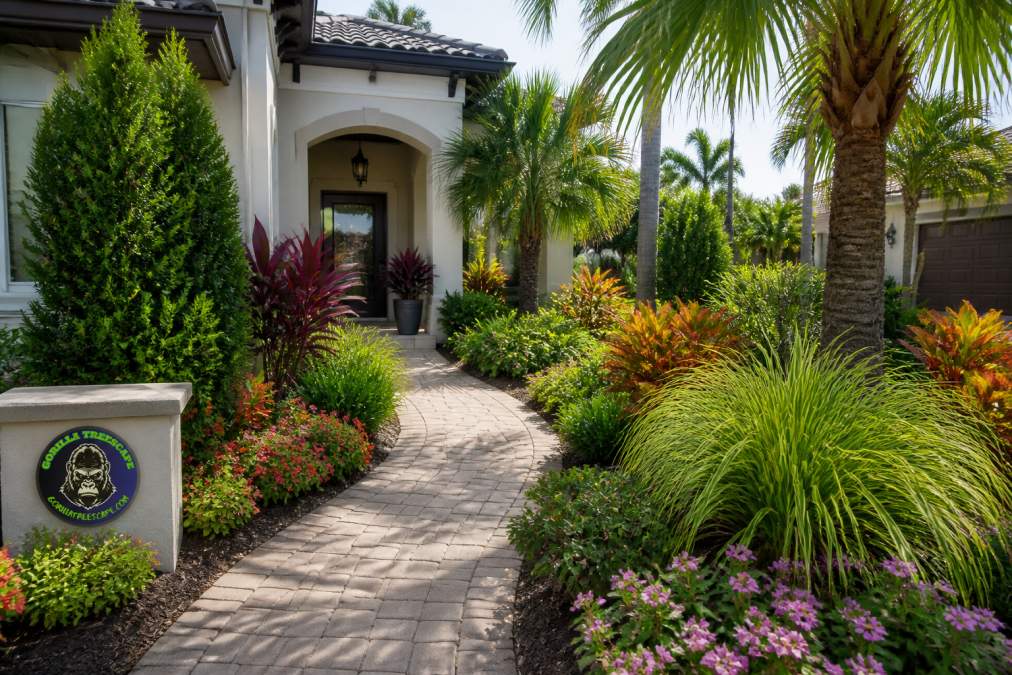
Layering is what separates a designed yard from a planted one:
- Back layer: tall evergreen shrubs and small specimen trees for height and screening
- Middle layer: medium shrubs with contrasting texture, such as variegated or fine-leaf varieties
- Front layer: ornamental grasses and ground cover that soften the bed edge
- Accent layer: seasonal color in containers or small beds near the entry
Symmetry matters most at the entry: matching plantings on either side of the door frame the entrance and make the home look balanced. Scale matters everywhere else, a shrub that matures to eight feet does not belong under a low window.
For homeowners who want the look without the upkeep, artificial green wall installation suits shaded entry walls and courtyards where live plants struggle. It holds color through the dry season and needs no irrigation.
Low Maintenance Garden Design Ideas That Still Look Expensive
Low maintenance garden design ideas work when they reduce the decisions the yard needs each month: fewer annual replacements, more evergreen structure, and ground cover instead of bare mulch. The goal is a yard that looks deliberate on listing day and the 300 days before that.
The design moves that deliver the most for the least ongoing work:
- Repeat a small plant palette. Three to five species used in mass reads as intentional and cuts maintenance variety.
- Use ground cover instead of open mulch. It suppresses weeds and holds moisture.
- Switch to drip irrigation on a timer. Targeted watering beats sprinklers for beds and reduces waste.
- Choose native plants. They are adapted to local rainfall and soil, so they need less intervention.
- Edge beds once, properly. A clean, deep edge holds its line far longer than a shallow one.
- Group containers at the entry. One focal point is easier to maintain than five scattered pots.
Mulch still has a role: a fresh, even layer instantly sharpens bed lines and is one of the cheapest visual upgrades available.
Walkways, Edging, and Entry Paths: The Details That Sell the Look
- Path width of 36 to 48 inches so two people can walk side by side
- Consistent paver pattern and joint lines, with no mismatched repairs
- A clear transition at the driveway, such as a flush border or a slight step
- Edging that sits flush with the lawn so mowing is clean
- Lighting placed along the path every 6 to 8 feet, not just at the door
- Slope of 1 to 2 percent away from the house for drainage
Budget and maintenance time vary by material and installation method. Use this table to plan your project:
| Material | DIY or Pro | Typical Lifespan | Upkeep Hours per Week | Best Climate | Best Home Style |
|---|---|---|---|---|---|
| Concrete pavers | Pro | 25-50 years | 0.5 | Hot, humid; freeze-thaw | Modern, Ranch |
| Clay brick | Pro | 20-30 years | 0.5 | Temperate | Colonial, Traditional |
| Gravel | DIY | 5-10 years | 1 | Arid, well-drained | Cottage, Ranch |
| Flagstone | Pro | 30+ years | 0.5 | Any | Mediterranean, Modern |
Lighting, Containers, and Privacy Screening for Year-Round Impact
| Feature | Primary Job | Best Placement | Upkeep Level | Hours per Week | Budget Tier | Best Home Style |
|---|---|---|---|---|---|---|
| Landscape lighting | Visibility and drama after dark | Path, entry, specimen tree | Low | 0.5 | Tier 2 or 3 | Any |
| Containers and window boxes | Seasonal color at eye level | Flanking the entry | Moderate | 1-2 | Tier 1 or 2 | Modern, Colonial, Mediterranean |
| Privacy screening and hedges | Enclosure and screening | Property lines, utility areas | Low to moderate | 0.5-1 | Tier 2 or 3 | Ranch, Colonial, Mediterranean |
Match the lighting style to the home's architecture, modern homes suit linear, low-profile fixtures, while traditional homes suit lantern-style path lights.
Budget Tiers, Maintenance Time, and Matching Your Home's Architecture
Gorilla Treescape LLC handles permitting for projects in under two months, which matters when a redesign touches walkways, drainage, or structures. For ongoing care rather than a one-time build, landscaping and pool maintenance keeps the design looking the way it did on install day.
Frequently Asked Questions
What landscaping ideas boost curb appeal the most?
The highest-impact moves are a clean, defined entry path, layered plantings with year-round structure, and consistent edging. In hot, humid climates, choose heat-tolerant evergreens and ornamental grasses for structure, then add seasonal color in containers. Hardscaping like a paver walkway or stone border frames the yard and reduces maintenance. These elements work together to create visual interest and a welcoming first impression, which supports property value.
What is the rule of three in landscaping?
The rule of three groups plants or features in odd numbers (three, five, or seven) to create balance and natural flow. Odd numbers avoid the stiffness of even pairings and guide the eye through the landscape. Apply it to specimen plants, containers, or lighting fixtures. For example, cluster three matching shrubs at different heights near the entry, or repeat three boulders along a bed. This technique adds rhythm without looking forced.
How can low-maintenance plants enhance a home's exterior?
Low-maintenance plants like native shrubs, ornamental grasses, and succulents reduce pruning, watering, and replacement costs. They also keep the yard looking tidy between visits, which matters for curb appeal. In humid areas, choose disease-resistant varieties to avoid frequent spraying. Group plants with similar water needs to simplify irrigation. A well-designed low-maintenance bed still delivers texture and color, but demands less time and money over the long run.
What role does hardscaping play in modern curb appeal design?
Hardscaping defines spaces, improves drainage, and adds year-round structure that plants alone cannot provide. A paver walkway, stone retaining wall, or decorative edging creates clean lines and guides visitors to the entry. In wet climates, proper grading and permeable surfaces prevent erosion and puddling. Hardscaping also reduces mulch and lawn areas, cutting maintenance. When balanced with softscaping, it gives the landscape a polished, architectural look that boosts curb appeal.